GOVERNMENT OF ETHIOPIA
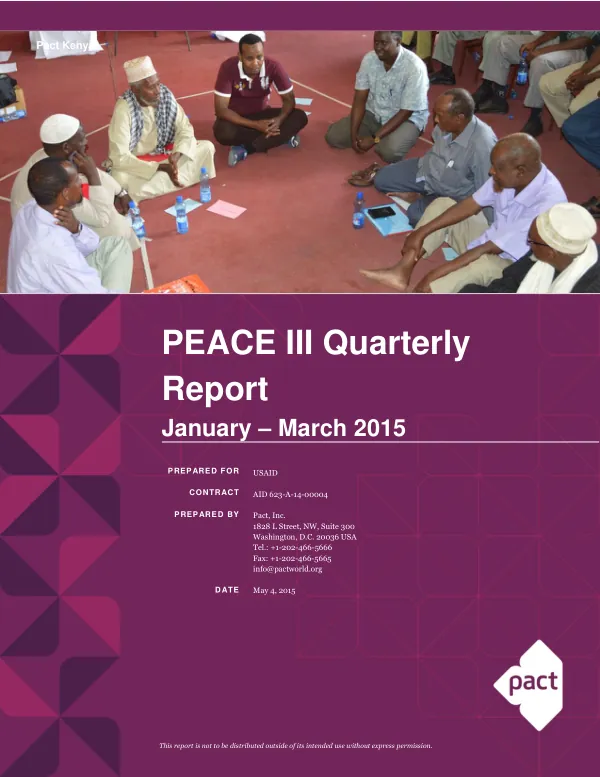
USAID KENYA AND EAST AFRICA (PEACE III) FY 2016 Q2 PROGRESS REPORT
The Peace III program in Kenya and East Africa is a USAID-funded initiative aimed at promoting peace and stability in the region.
2016 · 36 pages
Sign in to readA free account is required to download.
Abstract
The program focuses on addressing divisions between communities, and between citizens and State structures, to close the gaps that enable extremism and fuel radicalization. In the second quarter of fiscal year 2016, the program continued to implement its activities, with a focus on implementing CVE interventions in the Somali Cluster. The program supported a number of successful processes, including the Mandera County Government's request for support in reviving its Community Policing Unit (CPU), the ongoing peace processes between the Degodia and Gare communities, and the natural resource management agreement being developed between the Turkana, Dassenach, and Nyangatom communities. Increasing emphasis was given to implementing CVE interventions in the Somali Cluster, driven by the funding streams into PEACE III and the increasing challenges of extremism and radicalization seen along the Kenya and Somalia border. Community engagement in security and peace building was also a key focus of the program. The program supported CPU efforts that enhance communities' efforts to engage with government on peace and security matters, and engaged communities to discuss the challenges and opportunities for youth and women with regards to radicalization. These initiatives are about trust building, communication, and institutional support, using the approaches of peace building to work on CVE. All Peace Dividend projects have now been handed over to communities and government, to support connectors and improved relations between previously conflicting groups. Partners will continue to follow up on these projects to determine the extent to which they are playing a role as peace promoters. The program also spent time and resources looking into two peace dividend projects that were committed under the USAID TIS program in Dobley and Kolbio. The Somali Cluster remains a challenging environment to operate, with issues of access, security, and suspicion. The security wall being constructed by the Government of Kenya will pose additional challenges to this cross-border program, as well as the communities living in these areas. PEACE III will continue to follow these developments and engage with national partners to influence and adapt. In the Karamoja cluster, a shift has been made towards integrating climate change and conflict programming. This is due to funding interests, but also as some areas of the zone have seen an intensification of conflict due to drought, or require consolidation of peaceful relationships through the establishment of clearer resource management arrangements. A recent meeting with government to share findings of a study on climate change and conflict indicated the lack of connections made between sectors. The program has supported the development of resource sharing and management agreements between parties in different stages of conflict. This focus on climate change adaptation through a resilience pathway sees an approach premised in the belief that if communities are stable and peaceful, with improved relationships that enables communal use of resources, then their resilience to stress and shocks increases. PEACE III thus supported the Loyolo agreement between Turkana and Dodoth that has enabled Turkana to access pasture and water in Uganda, and is also supporting the agreement process between the Dassenech and Turkana that will allow access to water and pasture in Todonyang area of Turkana, by the Dassenech. The greatest challenge to work in the Karamoja cluster at present is the continued conflict in South Sudan, which makes access extremely difficult and has resulted in significant humanitarian concerns.
Related documents