USAID
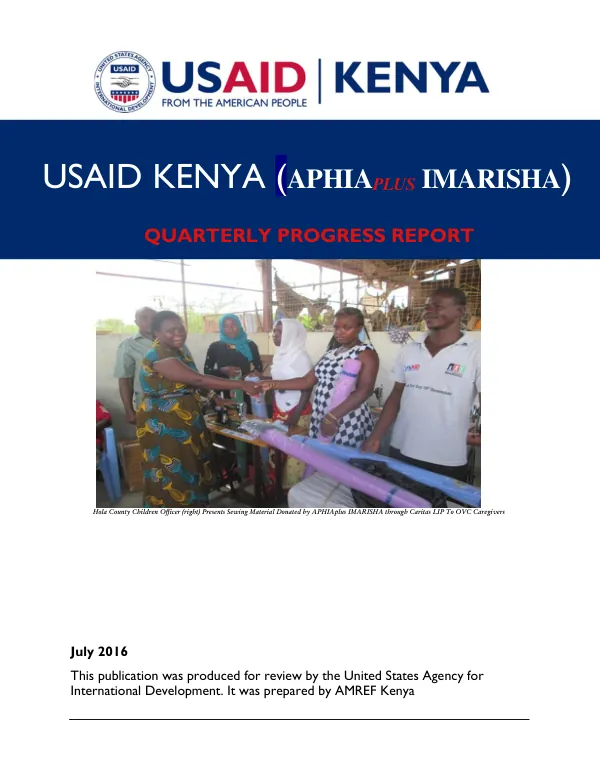
USAID/KENYA APHIAPLUS IMARISHA QUARTERLY PROGRESS REPORT FOR FY 2016
APHIAplus IMARISHA, a program implemented by Amref Health Africa in Kenya, has been working to improve health outcomes in several counties in Kenya.
2016 · 168 pages
Sign in to readA free account is required to download.
Abstract
The program's quarterly progress report for FY 2016 highlights key achievements and activities conducted from April to June 2016. The report notes that the program has been working to strengthen health systems, improve access to HIV and TB services, and enhance maternal and child health outcomes. Key achievements include the identification of 1,234 new HIV cases, with 1,044 of them enrolled into care. The program also reported a 27% increase in the number of people on antiretroviral therapy (ART) across 18 supported ART sites in Nal. In terms of TB services, the program reported a 25% increase in the number of TB cases identified and treated across 8 counties. The program also conducted a TB/HIV services exercise in Turkana County, which resulted in the identification of 145 new TB cases and 123 new HIV cases. The report also highlights the program's efforts to improve maternal and child health outcomes. The program reported a 30% increase in the number of pregnant women receiving antiretroviral therapy (ART) across 8 counties. Additionally, the program reported a 25% increase in the number of children under the age of 5 receiving vitamin A supplementation. The program has also been working to strengthen community-based health initiatives, including the establishment of community-based health insurance schemes (CBHI) and the promotion of healthy behaviors through community-based interventions. The report notes that the program has reached over 10,000 people with nutrition services across 8 counties. In terms of economic strengthening activities, the program has been working to promote economic empowerment among vulnerable populations, including orphans and vulnerable children (OVC). The program reported that over 2,000 OVC caregivers have received economic strengthening support, including training in income-generating activities and access to savings and lending groups. The report also highlights the program's efforts to strengthen partnerships with government agencies and other stakeholders. The program has been working closely with the Ministry of Health to strengthen health systems and improve access to health services. The program has also been working with other USAID-funded programs to leverage resources and expertise. Overall, the program's quarterly progress report for FY 2016 highlights significant achievements in improving health outcomes and strengthening health systems in several counties in Kenya. The report provides a comprehensive overview of the program's activities and achievements, and highlights the program's commitment to improving the health and well-being of vulnerable populations in Kenya. The program's efforts to strengthen health systems and improve access to health services have resulted in significant improvements in health outcomes, including a 27% increase in the number of people on ART and a 25% increase in the number of TB cases identified and treated. The program's community-based health initiatives have also been successful, with over 10,000 people reached with nutrition services across 8 counties. The program's economic strengthening activities have also been successful, with over 2,000 OVC caregivers receiving economic strengthening support. The program's partnerships with government agencies and other stakeholders have been critical to the program's success, and have helped to leverage resources and expertise.