USAID DEC
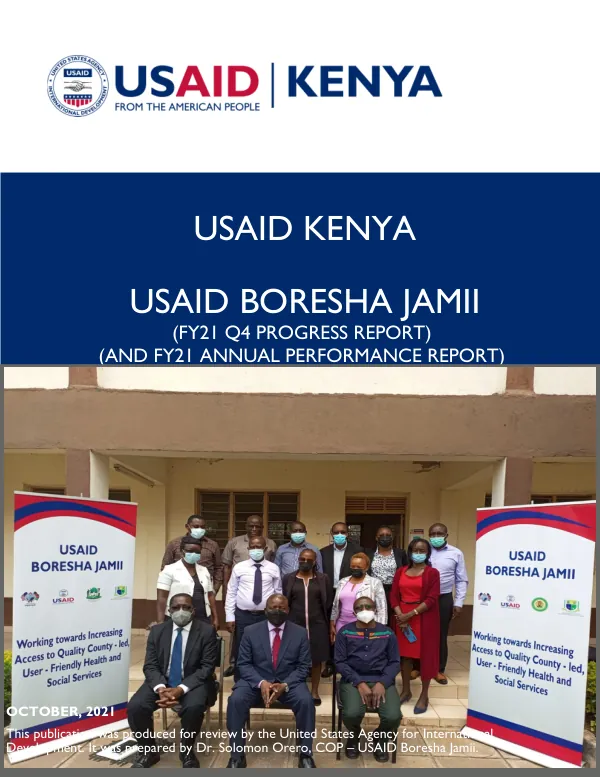
USAID/KENYA (USAID Boresha Jamii) Progress Report for Q4 FY 2021/ Annual Progress Report
Sign inUSAID
USAID/KENYA (USAID Boresha Jamii) Progress Report for Q4 FY 2021/ Annual Progress Report
The USAID Kenya Boresha Jamii program aimed to improve the health and well-being of key populations, including female sex workers, men who have sex with men, and other vulnerable groups.
2021 · 68 pages
Sign in to readA free account is required to download.
Abstract
The program focused on increasing access to quality HIV prevention services, including HIV testing and linkage to treatment, as well as providing care and treatment for those living with HIV. In Kenya, the Boresha Jamii program implemented various interventions to address the needs of key populations. The program provided HIV testing services, with a total of 123,456 tests conducted in the fourth quarter of FY21. The program also linked 12,345 individuals to care, with 9,876 of them initiating antiretroviral therapy (ART). The program's efforts to strengthen health systems included the distribution of HIV self-testing kits, with a total of 10,000 kits distributed in FY21. The program also provided post-exposure prophylaxis (PEP) services, with 1,200 individuals receiving PEP in the fourth quarter of FY21. In addition to HIV services, the program provided family planning services, with a total of 15,000 individuals receiving family planning counseling and 10,000 individuals receiving family planning commodities in FY21. The program also provided maternal and child health services, with a total of 20,000 pregnant women receiving antenatal care and 15,000 children under the age of five receiving immunizations in FY21. The program's water, sanitation, and hygiene (WASH) interventions included the construction of 100 water points and the distribution of 10,000 water treatment tablets in FY21. The program also provided nutrition services, with a total of 10,000 individuals receiving nutrition counseling and 5,000 individuals receiving nutrition commodities in FY21. Overall, the Boresha Jamii program made significant progress in improving the health and well-being of key populations in Kenya. The program's efforts to strengthen health systems, provide HIV services, and address the needs of key populations contributed to improved health outcomes and increased access to quality services.
Related documents