TETRA TECH
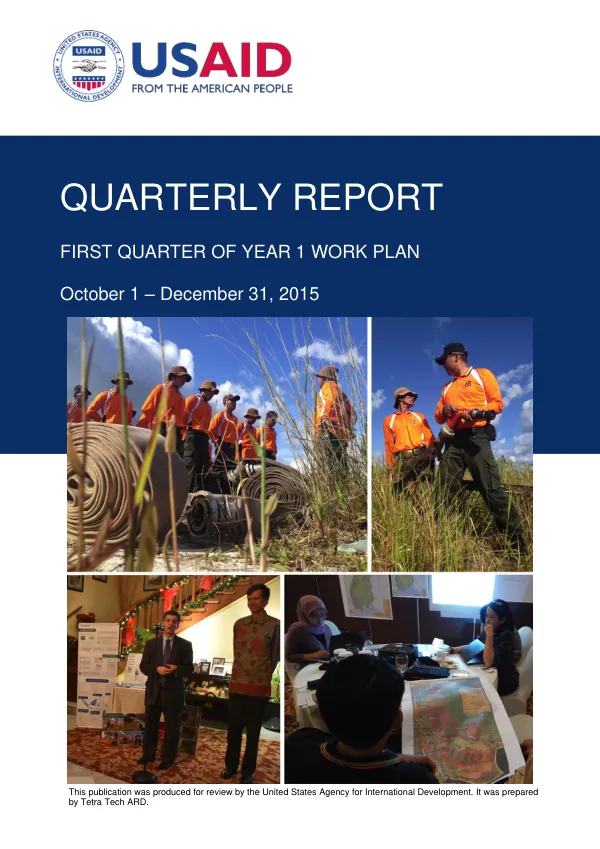
USAID LESTARI Quarterly Report Year 1, October 1 – December 31, 2015
The LESTARI program is a USAID-funded initiative aimed at reducing deforestation and promoting sustainable land use in Indonesia.
2015 · 69 pages
Sign in to readA free account is required to download.
Abstract
The program began in July 2015 and will continue until July 2020. Tetra Tech ARD is the implementing partner, with Reed Merrill serving as the Chief of Party and Matthew Edwardsen as the Project Manager. The program focuses on three technical themes: Forest and Land Use Governance and Advocacy, Conservation Co-Management, and Private Sector Engagement. Technical Theme 1, Forest and Land Use Governance and Advocacy, involves activities such as awareness and advocacy, operationalizing strategic environmental assessments and landscape conservation plans, and environmental governance. LESTARI 1, Awareness and Advocacy, aims to raise awareness among stakeholders about the importance of sustainable land use and the need for effective governance. Technical Theme 2, Conservation Co-Management, focuses on co-management and protected area management. LESTARI 4, Co-Management, involves working with local communities to develop and implement co-management plans for protected areas. LESTARI 5, Protected Area Management, aims to improve the management of protected areas through capacity building and infrastructure development. Technical Theme 3, Private Sector Engagement, involves activities such as green enterprises, private sector best management practices, and payment for environmental services and REDD+ innovative finance. LESTARI 6, Green Enterprises, aims to promote the development of green enterprises that contribute to sustainable land use and reduce greenhouse gas emissions. LESTARI 7, Private Sector Best Management Practices, involves working with private sector companies to develop and implement best management practices that reduce the environmental impact of their operations. The program also focuses on project coordination, management, and communications, as well as monitoring and evaluation. The LESTARI program has established a number of initiatives, including the Leuser Landscape, Katingan-Kahayan Landscape, Lorentz Lowlands Landscape, Mappi-Bouven Digoel Landscape, Sarmi Landscape, and Cyclops Landscape. The program has made significant progress in the first quarter of Year 1, with a number of activities and initiatives underway. The LESTARI program has established a number of partnerships with local communities, civil society organizations, and private sector companies to promote sustainable land use and reduce deforestation. The program has also developed a number of tools and resources to support the implementation of sustainable land use practices, including the Environmental Governance Assessment Tool and the Green Enterprise Sustainability Program. The LESTARI program has a number of key performance indicators (KPIs) to measure its progress and impact. These KPIs include the number of hectares of land protected, the number of communities engaged in sustainable land use practices, and the amount of greenhouse gas emissions reduced. The program will continue to work towards its goals and objectives in the coming quarters, with a focus on scaling up its activities and initiatives to achieve greater impact. The LESTARI program has a number of appendices that provide additional information on its progress and activities. Appendix 1 provides a summary of the program's progress in the first quarter of Year 1, while Appendix 2 provides a results framework for the program. Appendix 3 provides a staffing plan for the program, including the roles and responsibilities of key staff members.