LINC LLC
USAID Local Systems Practice Tublay SNA
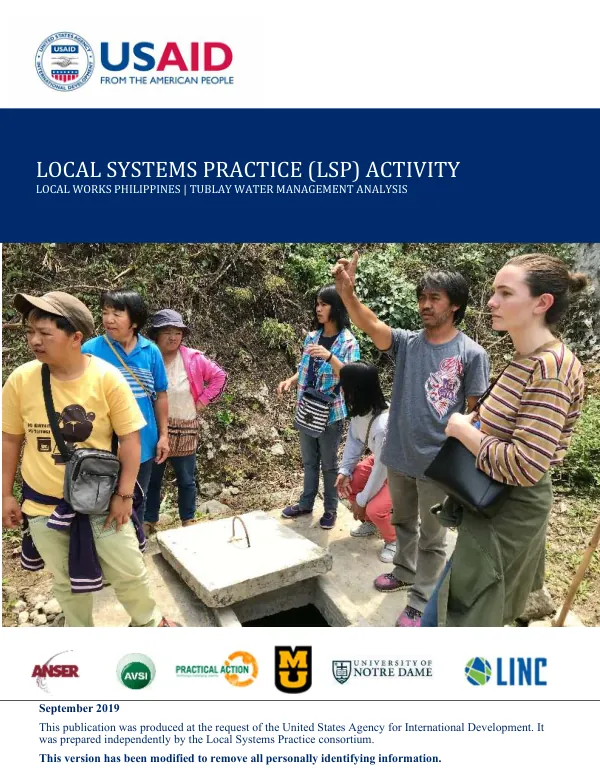
The Local Systems Practice (LSP) consortium, led by LINC, conducted a research study in the municipality of Tublay, Philippines, to support the USAID/Philippines Local Works team with insight into water management.
2019 · 73 pages
Sign in to readA free account is required to download.
Abstract
The study employed Social Network Analysis (SNA) to increase understanding of collaboration among key actors operating with formal or informal mandates to support water management in Tublay. The objectives of the study were to increase understanding of collaboration among key actors and to inform additional research needs and/or potential interventions to improve water access for the residents of Tublay. The SNA roster included a variety of actors involved in water management, including government offices, water source owners and rights holders, community-based organizations, the private sector, and academia. The methodology relied on an initial scoping visit and five focus group discussions (FGDs) in Tublay to develop a roster of 82 actors. The study aimed to identify key actors, their relationships, and the types of support exchanged among them. The findings of the study are presented in the subsequent sections. The study identified several key actors involved in water management in Tublay, including the Municipal Planning and Development Office, the National Irrigation Administration, the Municipal Health Office, Kalahi-CIDSS, and Waterworks Associations. These actors played important roles in water management, including planning, implementation, and maintenance. The study also analyzed the types of support exchanged among the actors, including information exchange, labor exchange, financial and in-kind support exchange, and "other" support exchange. The analysis revealed that the actors exchanged a range of support, including technical assistance, training, and financial resources. The study's findings have implications for improving water access in Tublay. The results suggest that strengthening collaboration among key actors and enhancing the exchange of support among them could improve water management in the municipality. The study's recommendations are presented in the subsequent sections. The study's methodology and findings provide valuable insights into the complex relationships among key actors involved in water management in Tublay. The results of the study can inform additional research needs and/or potential interventions to improve water access for the residents of Tublay. The study's analysis of the SNA roster revealed that the actors involved in water management in Tublay are diverse and complex. The roster included government offices, water source owners and rights holders, community-based organizations, the private sector, and academia. The actors played important roles in water management, including planning, implementation, and maintenance. The study's analysis of the types of support exchanged among the actors revealed that the actors exchanged a range of support, including technical assistance, training, and financial resources. The analysis also revealed that the actors had different levels of influence and control over water management in Tublay.
Related documents