USAID DEC
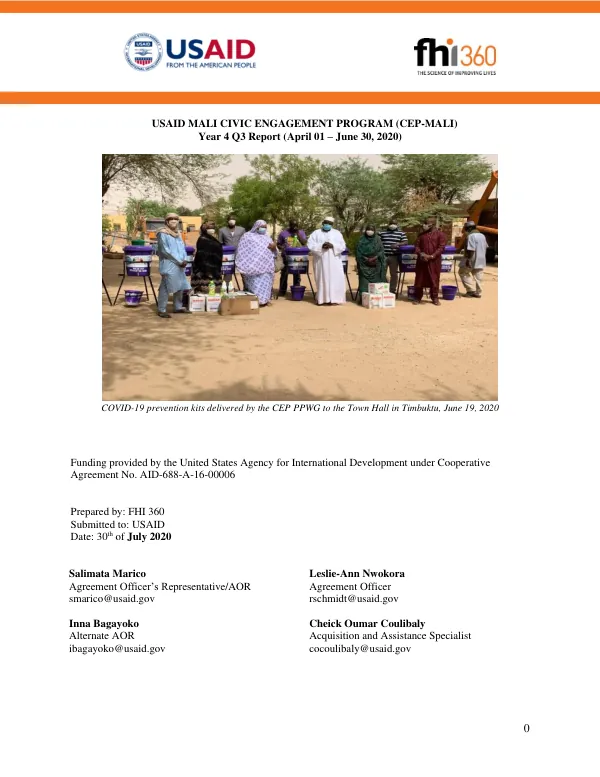
USAID Mali Civic Engagement Program (CEP-MALI) Year 4 Q3 Report (April 01 – June 30, 2020)
Sign inFAMILY HEALTH INTERNATIONAL 360
USAID Mali Civic Engagement Program (CEP-MALI) Year 4 Q3 Report (April 01 – June 30, 2020)
The USAID Mali Civic Engagement Program (CEP-MALI) is a five-year initiative that aims to improve public accountability by increasing and strengthening citizens' role in the community development process.
2020 · 53 pages
Sign in to readA free account is required to download.
Abstract
The program, which runs from 2016 to 2021, has a total budget of $12 million and is implemented by Family Health International (FHI 360). The program's goal is to achieve three main objectives: 1) strengthening mechanisms of bottom-up social accountability, 2) improving effective collaboration among civil society organizations (CSOs), the Government of Mali (GoM), and the private sector to develop public policy and advance issues of common interest, and 3) increasing citizens' understanding of rights and responsibilities to feel empowered to engage with the GoM. During the third quarter of the fourth year of implementation, CEP-MALI accomplished several activities to achieve its program objectives and results. Under objective 1, the program continued the implementation of 08 GGB processes planned for the program, held 58 forums to strengthen community groups' participation in decision-making processes and improve access to information and the quality of health, education, and WASH services, and established and facilitated 116 external control mechanisms for the use of public resources. Under objective 2, the program finalized a SCALE+ small grant package with inputs from the Ministry of Youth and Sports on a youths' citizenry forums program, and with CPHDA and the GSB finalization of another SCALE+ small grant package to support the capacity building of social services management bodies and forums across the country for their accountability. The program also monitored the activities of public-private partnership working groups in the six regions of CEP's intervention, mobilized government and elected officials for their support and participation in the program's activities, and met with other USAID partners on synergy opportunities and actions. Under objective 3, the program organized 47 training sessions on transparency-accountability, advocacy, gender and inclusion, and capacity building of CBOs, which brought together a total of 748 participants, including 462 men and 286 women, and among them 93 people with disabilities. The program also organized 9 capacity building sessions for elected officials and water point management organizations, including ASACO and water management committees, on WASH management and governance, and held 244 awareness sessions on local governance, local budgeting, accountability, advocacy, national legal texts and instruments, governance, the improvement of the services' delivery, and the inclusion and strengthening of civic engagement. In addition to these activities, the program produced and broadcasted 6 magazines and 6 grand dialogue radio programs to raise awareness on various issues such as albinism, the management of public resources, local governance with the use of a citizen audit tool, community members involvement in the management of their communes, the legislative elections, etc. The program also organized with Binthily communication, a Malian communication agency, the production of a broadcast and outreach communication program to be aired by 13 community radio stations across the 6 regions of CEP's intervention on decentralization, people's participation in decisions making processes, access to education for all, the respect for public goods, and the community involvement to improve WASH and health sectors. The country's political and security context during FY20 Q3 was marked by a large number of security incidents mainly driven by crimes in the north, and terrorist attacks in the center. Southern Mali also experienced a notable rise in security incidents. Despite these challenges, CEP-MALI continued to implement its activities and achieve its program objectives, with a focus on strengthening mechanisms of bottom-up social accountability, improving effective collaboration among CSOs, the GoM, and the private sector, and increasing citizens' understanding of rights and responsibilities to feel empowered to engage with the GoM.