MACEDONIAN MINISTRY OF AGRICULTURE, FORESTRY AND WATER ECONOMY
USAID MI2-WM Case Study: Chicken for Everyone
In the Republic of the Congo, communities around Nouabalé-Ndoki National Park rely heavily on wild meat for animal protein.
2023 · 5 pages
Sign in to readA free account is required to download.
Abstract
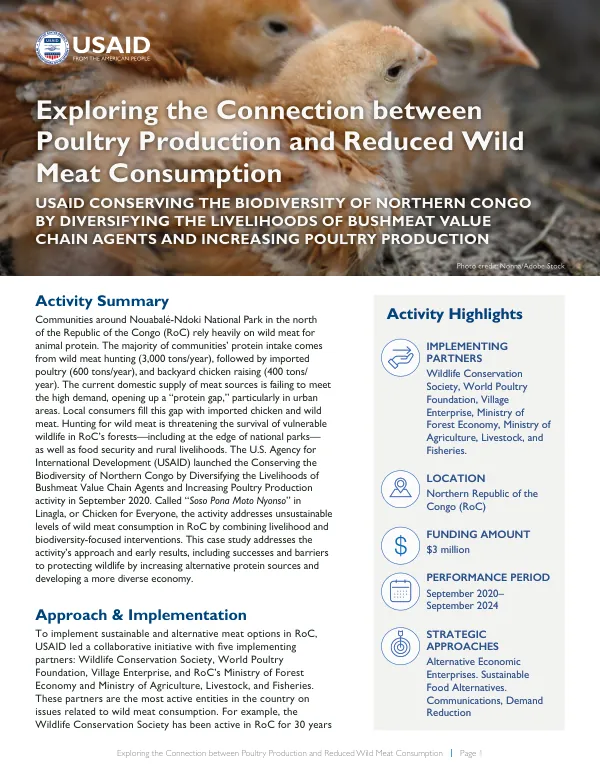
The majority of communities' protein intake comes from wild meat hunting (3,000 tons/year), followed by imported poultry (600 tons/year), and backyard chicken raising (400 tons/year). The current domestic supply of meat sources is failing to meet the high demand, opening up a "protein gap," particularly in urban areas. Local consumers fill this gap with imported chicken and wild meat. Hunting for wild meat is threatening the survival of vulnerable wildlife in RoC's forests, including at the edge of national parks, as well as food security and rural livelihoods. To address unsustainable levels of wild meat consumption in RoC, the U.S. Agency for International Development (USAID) launched the Conserving the Biodiversity of Northern Congo by Diversifying the Livelihoods of Bushmeat Value Chain Agents and Increasing Poultry Production activity in September 2020. Called "Soso Pona Moto Nyonso" in Linagla, or Chicken for Everyone, the activity combines livelihood and biodiversity-focused interventions. The activity applies an approach developed by the African Poultry Multiplication Initiative to overcome issues such as a lack of veterinary services, low egg production of local chicken breeds, high feed costs, and unmet feed demand. The activity's three-phase approach includes assessing potential protein substitutions, knowledge gaps, and sustainable methods to reduce wild meat consumption. Phase 1 identified chickens as a culturally acceptable substitute for wild meat in the target area, both for consumption and as a revenue source for community members in the wild meat value chain. Phase 2 implements the identified solutions to reduce wild meat consumption, including increasing poultry production by introducing brooding units of a new chicken breed (Sasso) and diversifying the incomes of bushmeat value chain actors by creating and operationalizing community household micro-enterprises. Phase 3 will scale up the activity over the next 12 months with support from private sector investors. The activity aims to reduce threats to biodiversity in RoC's northern forests by increasing poultry production as an alternative source of animal protein and diversifying the livelihoods of wild meat value chain actors. The activity's goals include developing a robust, well-researched, and implementable plan to increase poultry production in RoC and diversify the livelihoods of wild meat value chain agents. The activity also aims to understand the poultry value chain, source of credit, and partnerships in RoC, identify barriers to reducing the cost of poultry feed and the feasibility of producing alternative feed with zero deforestation, and access to veterinary services with comprehensive logistics for chicken health. The activity has seen increased interest from local communities in alternative livelihoods, with the activity now supporting more than 600 households engaged in more than 200 micro-enterprises. Implementation of Phase 3 should help the activity further its understanding of the effectiveness of alternative protein sources. The activity is also assessing community needs to support sustainable consumption and access to wild meat alternatives to the local communities, increasing local chicken production enables community members to plan their protein consumption and have more consistent access to a nutritious diet.
Related documents