USAID DEC
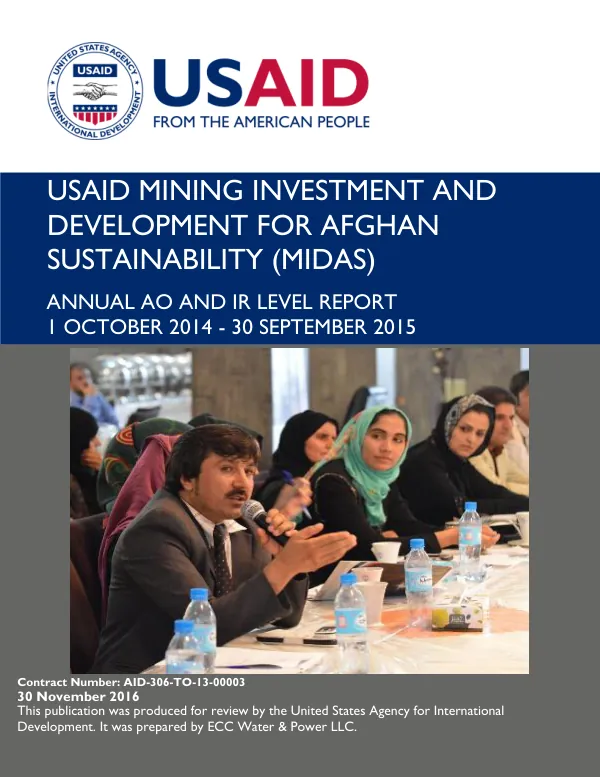
USAID MINING INVESTMENT AND DEVELOPMENT FOR AFGHAN SUSTAINABILITY (MIDAS) ANNUAL AO AND IR LEVEL REPORT
Sign inBANK FOR WEST AFRICAN DEVELOPMENT
USAID MINING INVESTMENT AND DEVELOPMENT FOR AFGHAN SUSTAINABILITY (MIDAS) ANNUAL AO AND IR LEVEL REPORT
The Mining Investment and Development for Afghan Sustainability (MIDAS) project is a four-year USAID/Afghanistan initiative to support an enhanced role for the private sector in Afghanistan's economic growth.
2014 · 27 pages
Sign in to readA free account is required to download.
Abstract
The project aims to generate rapid improvements to the Afghanistan government's income of at least $500 million a year in its Balance of Trade. The overarching task of MIDAS is to prepare a pipeline of eight to 10 large mineral projects and make them ready as tenders and contracts by the end of the MIDAS project in 2017. The project is divided into three components. Component I focuses on developing the legal and policy framework for the mining sector, including the development of a new Mining Law and regulations. Component II aims to strengthen the capacity of the Ministry of Mines and Petroleum (MoMP) and the Afghanistan Geological Survey (AGS) to develop a pipeline of mineral projects that can be brought to market. This component also includes targeted exploration work, including drilling, and technical and financial capacity development across MoMP and AGS Directorates. Component III focuses on supporting the private sector and mining project development, including building the general and technical capacity and knowledge of the MoMP and among communities, civil society organizations, and small and medium-sized enterprises (SMEs) on private sector development. This component also aims to promote transparency, anti-corruption, and gender considerations in the Extractive Industry. The project has made significant progress in the first year, with the development of a new Mining Law and regulations, the establishment of a pipeline of mineral projects, and the provision of technical and financial capacity development to MoMP and AGS staff. The project has also made progress in building the capacity of SMEs and promoting transparency and anti-corruption in the Extractive Industry. Key performance indicators (KPIs) have been established to measure the project's progress, including the development of a new Mining Law and regulations, the establishment of a pipeline of mineral projects, and the provision of technical and financial capacity development to MoMP and AGS staff. The project has achieved significant progress against these KPIs, with the development of a new Mining Law and regulations, the establishment of a pipeline of mineral projects, and the provision of technical and financial capacity development to MoMP and AGS staff. Challenges and constraints have been identified, including the need for further development of the legal and regulatory framework for the mining sector, the need for increased capacity building for MoMP and AGS staff, and the need for greater transparency and anti-corruption in the Extractive Industry. Lessons learned from the first year of the project include the importance of building strong relationships with stakeholders, the need for flexible and adaptive project management, and the importance of monitoring and evaluation. The project has made significant progress in the first year, with the development of a new Mining Law and regulations, the establishment of a pipeline of mineral projects, and the provision of technical and financial capacity development to MoMP and AGS staff. The project has also made progress in building the capacity of SMEs and promoting transparency and anti-corruption in the Extractive Industry. However, challenges and constraints remain, and the project will need to continue to adapt and evolve to meet the needs of the Afghan government and the private sector.