BANK FOR WEST AFRICAN DEVELOPMENT
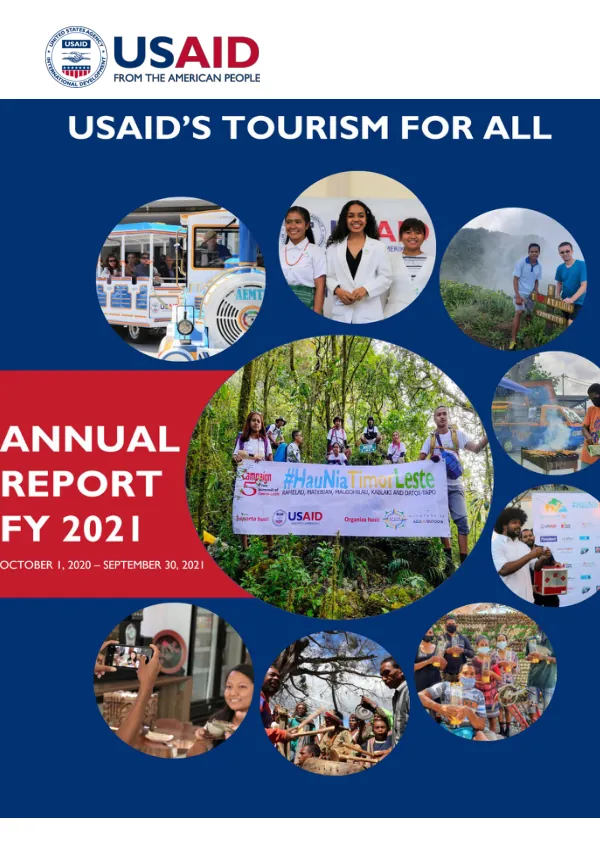
USAID’s Tourism for All Project Annual Report – FY 2021
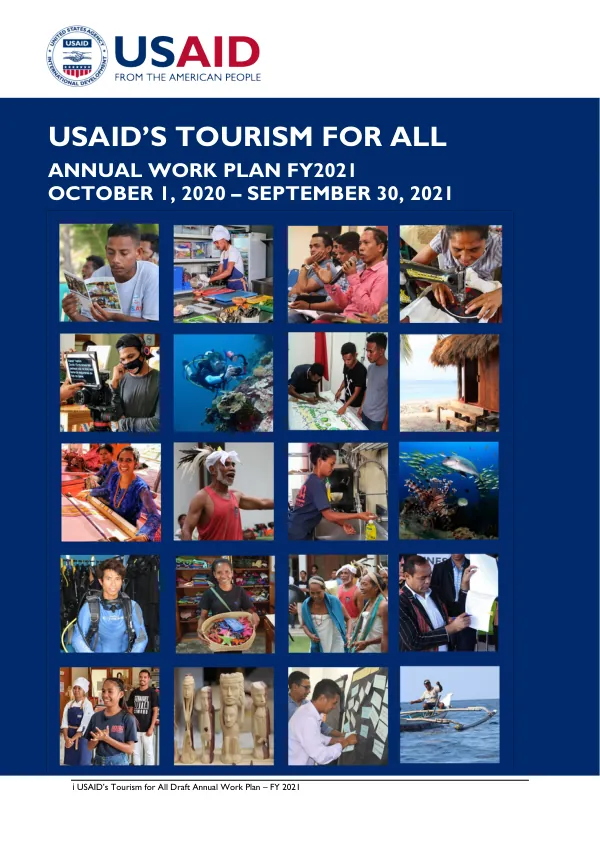
The USAID's Tourism for All Project is organized around the vision and objectives of the Timor-Leste National Tourism Policy, Growing Tourism to 2030-Enhancing a National Identity, which was ratified by the Council of Ministers in 2017.
2021 · 73 pages
Sign in to readA free account is required to download.
Abstract
The policy posits five overarching themes: Priority, Prosperity, Protection, Partnership, and People, through which government, industry, civil society, academia, and development partners should view tourism and focus their efforts to achieve the goal of tourism sector success and sustainability for the country. Building on the framework established through the National Tourism Policy, the USAID's Tourism For All Project is helping promote Timor-Leste's competitiveness as an international tourism destination while preserving its unique environmental and cultural heritage. The project aims to augment Timor-Leste's efforts to boost tourist arrivals to 200,000 annually by 2030, increase employment in tourism to 15,000 jobs, and generate US$150 million in annual tourism revenue. In FY2021, the project continued to navigate and respond to the challenges posed by the COVID-19 pandemic, which caused an ongoing hiatus in international leisure and business travel across the globe. The project ascribed to the USAID ethos of Collaborating, Learning, and Adapting (CLA) and continued many of the activities launched during FY2020 to help mitigate the COVID-19 chaos, such as the pivot to stimulating domestic tourism demand through the Ha'u-Nia Timor-Leste campaign. The project gained substantial exposure through its different activities, featuring on the front cover of the monthly Guide Post Magazine four times during FY2021. Other notable accomplishments during FY2021 include the approval by the Government of Timor-Leste (GoTL) of two tourism-related public private partnerships: Cristo Rei valued at US$ 2-4 million and Dili Port valued at close to US$ 100 million. The project will continue to support the GoTL to refine these projects for ultimate tendering as early as 2022. In addition, the project formalized four tourism-related associations, which bring together stakeholders with common interests into a community-of-practice for shared advocacy and development. These and other initiatives ensure that the project will leave a lasting legacy in Timor-Leste when implementation concludes in early 2023. The project supports the Mission's Country Development Cooperation Strategy goal of facilitating a more prosperous, healthy, and democratic Timor-Leste. In FY2021, the project set out to provide institutional support to help bolster tourism development and facilitate realization of the National Tourism Policy by facilitating the development of strategies and action plans at the national and municipal levels. The project worked alongside key government agencies to improve their capacity to better perform their duties in the nurturing sector growth. The project's efforts to support the development of tourism-related public private partnerships, formalize tourism-related associations, and provide institutional support to government agencies have contributed to the project's overall goal of promoting Timor-Leste's competitiveness as an international tourism destination while preserving its unique environmental and cultural heritage. The project's achievements in FY2021 have supported desired project results and activities scripted under Objectives 1 and 2, leading USAID to award the second of two option years to the project. The project's theory of change, stated on page 12 of this report, posits that by promoting Timor-Leste's competitiveness as an international tourism destination while preserving its unique environmental and cultural heritage, the project will contribute to the country's economic growth, poverty reduction, and improved quality of life. The project's efforts to support the development of tourism-related public private partnerships, formalize tourism-related associations, and provide institutional support to government agencies are expected to augment Timor-Leste's efforts to boost tourist arrivals, increase employment in tourism, and generate revenue from tourism.