USAID DEC
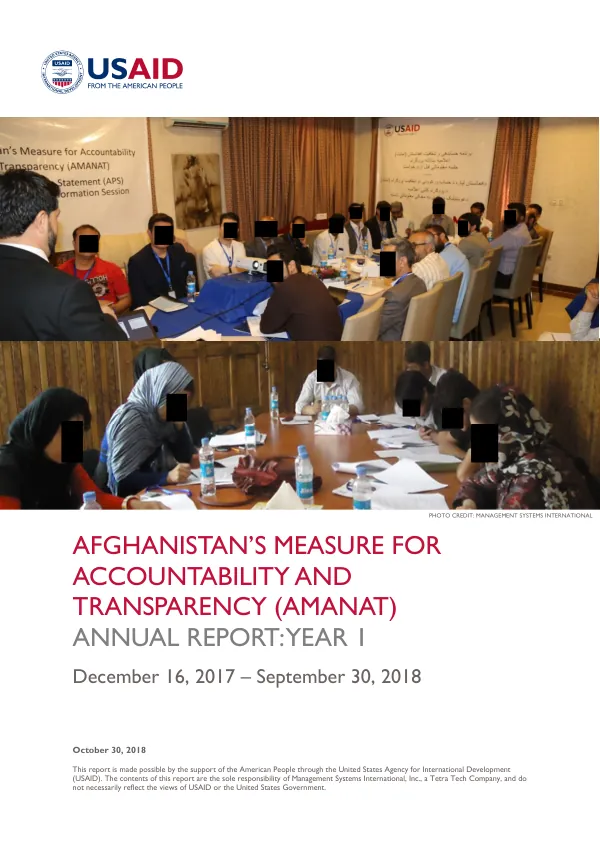
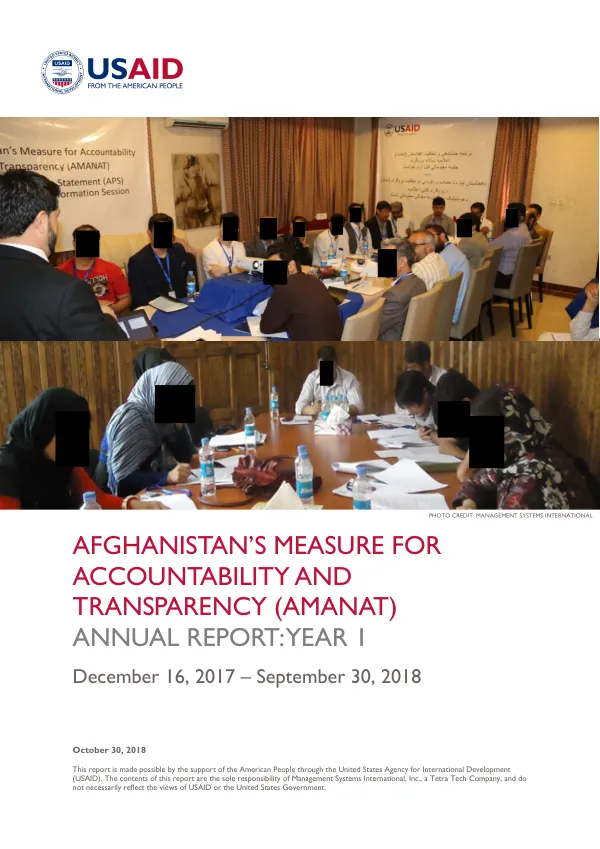
Afghanistan’s Measure for Accountability and Transparency (AMANAT) Annual Report: Year 1
Sign inGOVERNMENT OF THE ISLAMIC REPUBLIC OF AFGHANISTAN
Afghanistan’s Measure for Accountability and Transparency (AMANAT) Annual Report: Year 1
Afghanistan's Measure for Accountability and Transparency (AMANAT) project is a five-year anti-corruption initiative that aims to support the Afghan government's efforts to reduce and prevent corruption in government public services.
2018 · 31 pages
Sign in to readA free account is required to download.
Abstract
The project engages with both government and nongovernmental organizations to strengthen transparency and accountability mechanisms and build civil society's ability to advocate for reform. The project has two components. Component 1 focuses on strengthening government institutions and civil society organizations (CSOs) to identify vulnerabilities to corruption in the delivery of public services and develop corresponding recommendations to address these vulnerabilities. Component 2 is a special programming mechanism that allows USAID to issue task orders to the AMANAT project to address tasks that are not covered in Component 1. During the first year of operations, the project conducted a political economy analysis (PEA) of corruption, which identified reforms that are likely to have the highest impact on Afghan government revenues and public service delivery. The project also designed and began to implement a new PEA study, conducted workshops for the Afghanistan Independent Joint Anti-Corruption Monitoring and Evaluation Committee (MEC) and the MEC Secretariat staff on the MSI Vulnerability to Corruption for Reform (VCA-R) approach, and released the first year's Annual Program Statement (APS) calling for CSO grant proposals. The project also conducted five grants workshops, including four Grant Concept Note Workshops and one Grant Workshop, and evaluated ten grant proposals. Additionally, the project released a call for proposals for small businesses to provide Business Process Redesign capacity building and technical support services, developed a CSO database of CSOs working on anti-corruption issues, and established working relationships with key CSOs in Kabul. The project's objectives are to improve the performance, legitimacy, and capacity of the Government of the Islamic Republic of Afghanistan (GIRoA) in fighting corruption and to reduce and prevent corruption in government public services and functions. To accomplish this, the project works at the national and subnational level to strengthen Afghan government institutions and CSOs, support select government institutions with technical assistance, and build the capacity of local CSOs to test and monitor the effectiveness of reforms. The project's approach focuses on willing institutions and applies innovative and tested methods to facilitate stakeholder buy-in and commitment, progress, sustainability, learning, and adaptation to reduce and prevent corruption. Once reforms are implemented, the project will monitor functions and processes to ensure their sustainability before turning to other institutions and services. Key accomplishments of the first year of operations include conducting a PEA of corruption, designing and implementing a new PEA study, conducting workshops for the MEC and MEC Secretariat staff, releasing the first year's APS, conducting five grants workshops, evaluating ten grant proposals, releasing a call for proposals for small businesses, developing a CSO database, and establishing working relationships with key CSOs in Kabul. The project has established working relationships with key GIRoA institutions, including the Parliamentary Anti-Corruption Caucus, High Council on Rule of Law and Anti-Corruption, the Special Anti-Corruption Secretariat, MEC, the Anti-Corruption Justice Center, Attorney General's Office, Supreme Audit Office, Ministry of Finance, Asan Khedmat in the Ministry of Information and Communications Technology, Ministry of Commerce and Industries, National Procurement Authority, and Senior Advisors in the Office of the President. The project's progress was affected by a stop work order issued shortly after the contract was awarded due to a contractual protest. As a result, the project operated on a fiscal year basis, and the first year's report covers the period from December 16, 2017, to September 30, 2018.
Related documents