DAI
USAID MUSHARIKAT Monthly Report
The USAID Musharikat project is a five-year initiative aimed at promoting women's equality and empowerment in Afghanistan.
2020 · 40 pages
Sign in to readA free account is required to download.
Abstract
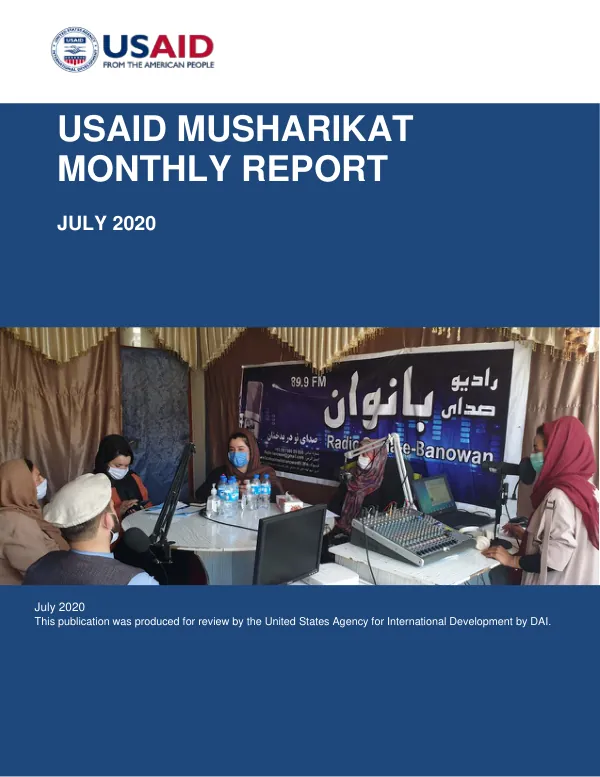
Awarded in September 2015, the project has a budget of $29.5 million and is designed to achieve four complementary objectives. The first objective is to build constituencies among national, provincial, and local activists and civil society organizations focused on promoting women's equality and empowerment. The second objective is to strengthen more effective advocacy for women's equality and empowerment. The third objective is to increase awareness of, and support for, women's rights in all 34 provinces in Afghanistan. The fourth objective is to increase the effectiveness of civil society and the Government of the Islamic Republic of Afghanistan in the development and implementation of gender policies, laws, and regulations. To achieve these objectives, the project works with civil society organizations and activists across all 34 provinces to prioritize and select the most critical issues that limit women's ability to exercise their rights and fully participate in Afghan society. The project employs an inclusive, transparent, and competitive process to bring together civil society organizations and activists to form coalitions, each designed to tackle a priority concern as determined by Afghan women. Led by Afghan women leaders, these coalitions engage with a wide set of stakeholders to help advance collective advocacy campaigns designed to strengthen women, families, communities, and the country. During the month of July, the project continued its efforts to empower women and promote gender equality across Afghanistan while adapting to the increase in reported COVID-19 cases, an increase in violence, and a delay in the much-anticipated Intra-Afghan peace talks. The project carried out more than 290 activities supporting all four objectives. The COVID-19 global pandemic seriously impacted not only the activities of Musharikat but all other functions of life in Kabul and the whole of Afghanistan. In order to protect its staff and their communities from infection, Musharikat continued to adhere to instructions to 'work from home' from USAID and the Government of the Islamic Republic of Afghanistan. Training and advocacy activities continued to be held as planned, and COVID-19 protocols were adhered to. These included social distancing, mask-wearing, and ensuring that participants were aware of the need for hand-washing. Radio roundtables and the Musharikat Knowledge Management Portal (MKMP) continued to be important tools for Musharikat activities, not only to reach remote populations but also considering restrictions on movement still in place. For Objective 1, Musharikat continued building its constituencies within coalitions using membership recruitment activities and online engagement. Thirteen new members joined coalitions this month. The steady increase in coalition members has contributed to the project's efforts to promote women's equality and empowerment in Afghanistan. For Objective 2, the project strengthened more effective advocacy for women's equality and empowerment through training and capacity-building activities. The project also increased awareness of, and support for, women's rights in all 34 provinces in Afghanistan through advocacy campaigns and community outreach activities. The project's efforts to increase the effectiveness of civil society and the Government of the Islamic Republic of Afghanistan in the development and implementation of gender policies, laws, and regulations have been ongoing throughout the month. The project has been working closely with government partners to develop and implement policies and laws that promote women's equality and empowerment. The project has also been providing technical assistance and capacity-building support to civil society organizations to enhance their ability to advocate for women's rights and empowerment. Overall, the USAID Musharikat project has made significant progress in promoting women's equality and empowerment in Afghanistan. The project's efforts to build constituencies, strengthen advocacy, increase awareness, and enhance the effectiveness of civil society and the government have contributed to the project's overall objective of promoting women's equality and empowerment in Afghanistan.