DAI
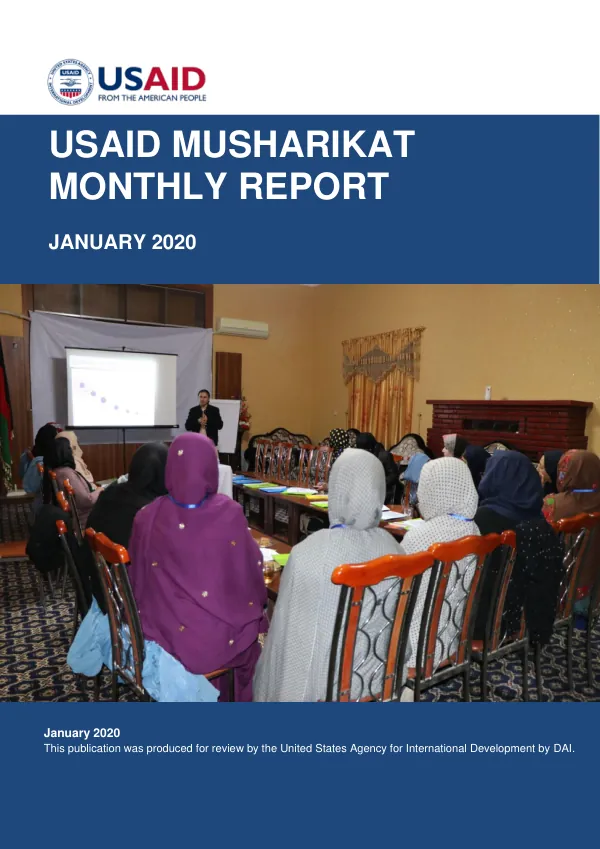
USAID Musharikat Monthly Report (January 2020)
The USAID Musharikat project is a five-year initiative aimed at promoting women's equality and empowerment in Afghanistan.
2020 · 26 pages
Sign in to readA free account is required to download.
Abstract
Awarded in September 2015, the project has a budget of $29.5 million and is designed to achieve four complementary objectives. The first objective is to build constituencies among national, provincial, and local activists and civil society organizations focused on promoting women's equality and empowerment. The second objective is to strengthen more effective advocacy for women's equality and empowerment. The third objective is to increase awareness of, and support for, women's rights in all 34 provinces in Afghanistan. The fourth objective is to increase the effectiveness of civil society and the Government of the Islamic Republic of Afghanistan in the development and implementation of gender policies, laws, and regulations. To achieve these objectives, the project works with civil society organizations and activists across all 34 provinces to prioritize and select the most critical issues that limit women's ability to exercise their rights and fully participate in Afghan society. The project employs an inclusive, transparent, and competitive process to bring together civil society organizations and activists to form coalitions, each designed to tackle a priority concern as determined by Afghan women. Led by Afghan women leaders, these coalitions engage with a wide set of stakeholders, including interested citizens, government and private sector partners, community and religious leaders, and media, to help advance collective advocacy campaigns designed to strengthen women, families, communities, and the country. The project's Coalitions for Change (C4C) approach is a key component of its strategy to strengthen women-focused civil society organizations and activists' ability to effectively advocate for women's rights and empowerment in Afghanistan. The C4C approach involves the formation of inclusive, broad-based coalitions through transparent and competitive processes, each of which focuses on a single issue. The project serves as a mentor, advisor, facilitator, and funder to the coalitions and grantee civil society organizations, providing the necessary technical advice and resources to conduct outreach and awareness-raising initiatives, build broad-based constituencies to support coalition objectives, form strategic alliances at the local, regional, and international levels, plan and execute advocacy campaigns, and establish constructive working relationships with GIRoA partners on policy and legislative matters. In January 2020, under Objective 1, Musharikat continued to engage its members through its online platforms, establishing new project monthly highs in "number of discussion forum posts" (962) and "number of discussion forum post member views" (10,563). The project also engaged its members through live event activities, including peace process alliance building coordination meetings. Musharikat registered 186 new members this month. Under Objective 2, Musharikat trained 213 coalition members in persuasion training, which was effective for members. Ninety-one percent of all participants either "Strongly Agreed" or "Agreed" that the "Overall quality of the training was good." Eighty-nine percent of participants "Strongly Agreed" or "Agreed" that "My expectations were met" through the training. Over 91% of the participants answered that the "Training materials were useful" and that they were "Likely to use the training materials in the future." As part of its grant to advocate for the prevention of schoolgirls' harassment in Badakhshan and Takhar provinces, Musharikat provided training on provisions in the Elimination of Violence Against Women (EVAW) Law, the Law on the Prohibition and Prevention of Harassment of Women and Girls, National Education Policy, and public speaking skills for 84 members of the District Policy Advocacy Committees. Under Objective 3, Musharikat's Access to Justice (AJ) and Anti-Harassment of Women and Girls (AHWG) coalitions continued public awareness raising on anti-harassment issues.