USAID DEC
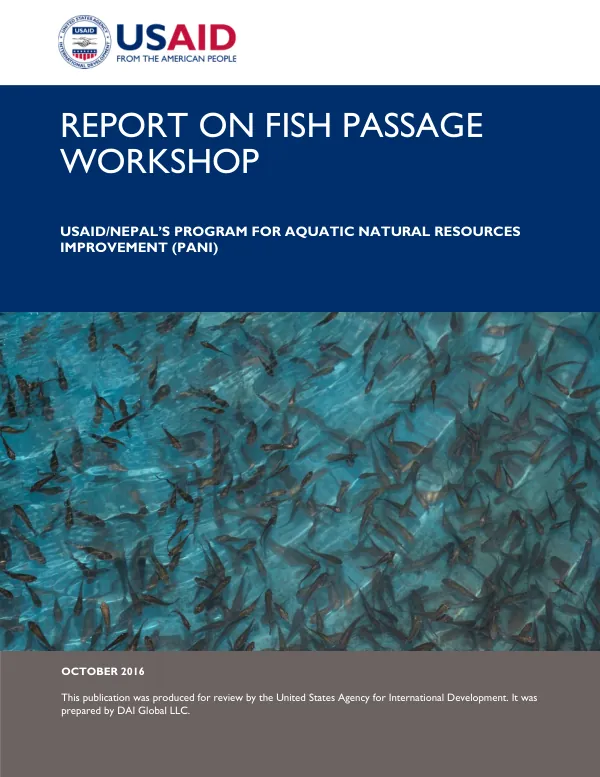
USAID/Nepal’s Program for Aquatic Natural Resources Improvement (PANI) Team Building Workshop Report
Sign inDEVELOPMENT ALTERNATIVES, INC./FINNET
USAID/Nepal’s Program for Aquatic Natural Resources Improvement (PANI) Team Building Workshop Report
The USAID/Nepal's Program for Aquatic Natural Resources Improvement (PANI) project aims to enhance Nepal's ability to manage water resources for multiple uses and users through climate change adaptation and the conservation of freshwater biodiversity.
2016 · 31 pages
Sign in to readA free account is required to download.
Abstract
The project is implemented in three river basins of Nepal, namely Mahakali, Karnali, and Rapti, and began in April 2016. The project's objectives include increasing knowledge, engagement, and benefits for local water users, improving basin-level resource management, and expanding the knowledge base. The project envisions several expected outcomes, including improving local capacity for water management, improving integrated planning and operation of hydropower, improving management of capture fisheries, improving local capacity for managing invasive species, and improving local capacity for management of roads and mining. To achieve these outcomes, the project will strengthen policies, institutions, and stakeholder relationships. A two-day team building workshop was conducted from August 23-24, 2016, to encourage project employees to feel ownership of the PANI project. The workshop was attended by 21 participants, including the Chief of Party (COP), Deputy COP, and experts in various fields. The workshop methodology included group work, individual work, and discussion. The workshop aimed to bring the team together and self-define responsibility under different Intermediate Results (IRs), Sub-IRs, and tasks under each sub-IR. The facilitator made several recommendations for improving team work, including effective stakeholders management, social mobilization, consultation, and communication. The project should analyze stakeholders to determine their level of interest in and influence over the project effort. The PANI project is a five-year project funded by USAID, and its implementation is crucial for enhancing Nepal's ability to manage water resources for multiple uses and users. The project's expected outcomes will contribute to reducing the threats to freshwater biodiversity and increasing the ability of targeted human and ecological communities to adapt to the adverse impacts of climate change. The project's success depends on the effective management of stakeholders, including local water users, civil society organizations, and government agencies. The project should prioritize social mobilization, consultation, and communication to understand and address the concerns of stakeholders. By doing so, the project can ensure the participation and ownership of stakeholders, ultimately leading to the achievement of its expected outcomes. The PANI project's expected outcomes will have a significant impact on Nepal's water resources management, climate change adaptation, and freshwater biodiversity conservation. The project's success will contribute to improving the livelihoods of local communities, enhancing the country's ability to manage water resources, and reducing the threats to freshwater biodiversity.
Related documents