USAID DEC
Semi-Annual Performance Report: Hariyo Ban Program
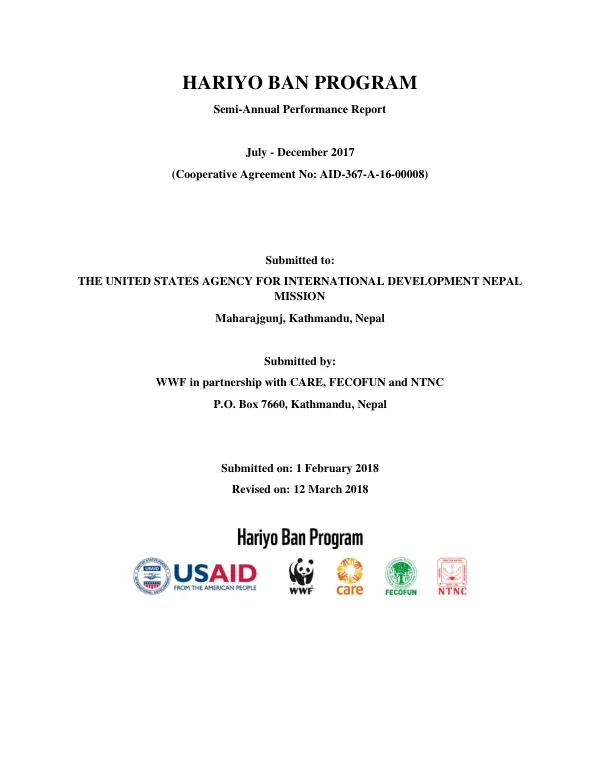
The Hariyo Ban Program is a semi-annual performance report submitted to the United States Agency for International Development (USAID) Nepal Mission.
2018 · 96 pages
Sign in to readA free account is required to download.
Abstract
The report covers the period from July to December 2017 and is submitted by WWF in partnership with CARE, FECOFUN, and NTNC. The program's goal is to conserve biodiversity, adapt to climate change, promote gender equality and social inclusion, and improve governance in the Terai Arc Landscape (TAL) and Chitwan Annapurna Landscape (CHAL). The working areas of the program include metropolitan cities, municipalities, and rural municipalities in TAL and CHAL. The semi-annual performance report highlights the program's progress in biodiversity conservation, climate change adaptation, gender equality and social inclusion, and governance. The report also discusses the program's overarching themes and activities, including the small grants program, communications, monitoring and evaluation, and sustainability. In the area of biodiversity conservation, the program has made significant progress in protecting and conserving natural habitats and species. The report highlights the establishment of community-based anti-poaching units, the protection of endangered species, and the promotion of sustainable forest management practices. The program has also made progress in climate change adaptation, including the implementation of local adaptation plans of action, the promotion of climate-resilient agriculture practices, and the establishment of early warning systems for climate-related disasters. In terms of gender equality and social inclusion, the program has made significant progress in promoting the rights and empowerment of women and marginalized communities. The report highlights the establishment of community learning and action centers, the promotion of women's participation in decision-making processes, and the implementation of income generation activities. The program has also made progress in governance, including the strengthening of community forest user groups, the promotion of participatory governance practices, and the establishment of district-level coordination committees. The report also highlights the program's challenges and anticipated future problems, including the need for increased funding, the complexity of the program's governance structure, and the need for improved monitoring and evaluation systems. The program's opportunities and prospects for the next reporting period include the potential for increased funding, the expansion of the program's geographic scope, and the opportunity to build on the program's existing successes. The report includes several annexes, including a list of planned and completed research, studies, and assessments, a performance indicator tracking table, and a draft resilience framework for the Hariyo Ban program. Overall, the Hariyo Ban program has made significant progress in conserving biodiversity, adapting to climate change, promoting gender equality and social inclusion, and improving governance in the Terai Arc Landscape and Chitwan Annapurna Landscape. The program's successes and challenges highlight the importance of continued support and funding for the program's activities and initiatives.
Related documents