USAID DEC
Middle Rapti Watershed Profile: Status, Challenges and Opportunities for Improved Water Resource Management
Sign inDAI GLOBAL, LLC
Middle Rapti Watershed Profile: Status, Challenges and Opportunities for Improved Water Resource Management
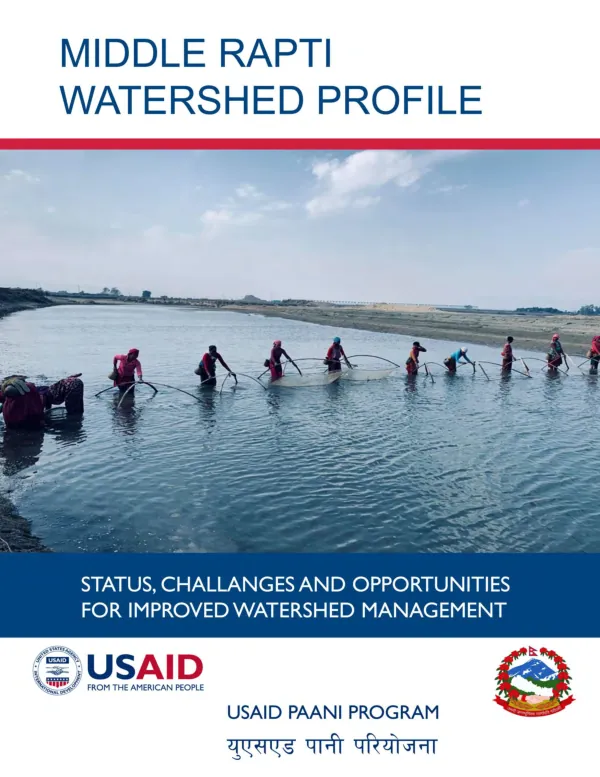
The Middle Rapti Watershed is a critical water resource management area in Nepal, spanning across several districts.
2019 · 97 pages
Sign in to readA free account is required to download.
Abstract
The watershed is characterized by a diverse range of ecosystems, including forests, grasslands, and agricultural lands. The region is home to a variety of plant and animal species, including several endangered species. Water availability and quality are significant concerns in the Middle Rapti Watershed. River and stream discharge rates vary throughout the year, with peak flows occurring during the monsoon season. Water quality test results indicate the presence of pollutants, including sediment, nutrients, and bacteria. Major pollution points in the watershed include agricultural runoff, industrial effluent, and domestic waste. Land use and land cover patterns in the Middle Rapti Watershed are dynamic and influenced by human activities. Forest cover has declined significantly over the years, with many areas converted to agricultural lands or urban settlements. Common plant species found in the watershed include grasses, shrubs, and trees such as Sal and Khair. However, invasive species like Lantana and Parthenium have also been identified as threats to biodiversity. Agriculture is a significant economic activity in the Middle Rapti Watershed, with many households relying on farming as their primary source of income. Crop productivity is influenced by factors such as soil fertility, irrigation, and climate. Soil management and fertility are critical issues, with many areas experiencing soil degradation due to intensive farming practices. Irrigation is also a significant concern, with many farmers relying on traditional methods that are often inefficient and unsustainable. Infrastructure development is essential for improving the livelihoods of people living in the Middle Rapti Watershed. Gravel mining is a significant economic activity in the region, but it also poses environmental risks, including sedimentation and habitat destruction. Road networks are limited, making it difficult for people to access markets and services. Irrigation projects are also essential for improving agricultural productivity and reducing water scarcity. Access to water, sanitation, and hygiene (WASH) facilities is a significant challenge in the Middle Rapti Watershed. Many households lack access to safe drinking water, sanitation, and hygiene facilities, leading to health risks and environmental degradation. Community forest groups and irrigation user groups are essential for managing natural resources and improving livelihoods. The Middle Rapti Watershed faces several environmental issues, including climate change, biodiversity loss, and water pollution. Climate change impacts are evident in the form of changing rainfall patterns, increased temperatures, and more frequent natural disasters. Biodiversity loss is a significant concern, with many plant and animal species facing extinction due to habitat destruction and overexploitation. Water pollution is also a significant issue, with pollutants from agricultural runoff, industrial effluent, and domestic waste affecting water quality. Recommendations for improving watershed health in the Middle Rapti Watershed include strengthening community-based management, improving infrastructure, and promoting sustainable agriculture practices. Community-based management is essential for ensuring that natural resources are managed in a sustainable and equitable manner. Improving infrastructure, including roads, irrigation systems, and WASH facilities, is critical for improving livelihoods and reducing poverty. Promoting sustainable agriculture practices, including agroforestry and conservation agriculture, can help reduce soil degradation and improve crop productivity.