DAI GLOBAL, LLC
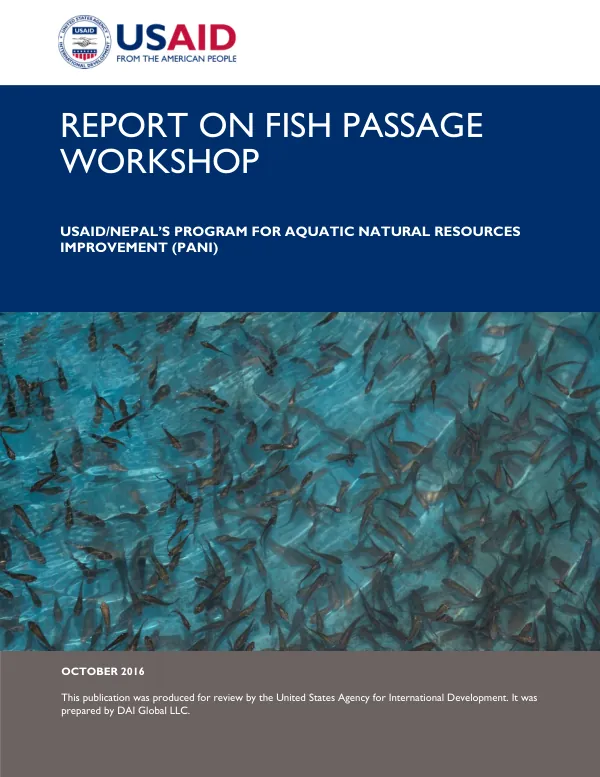
Report on Fish Passage Workshop
The Design and Operation of Fish Passages International Good Practices Workshop was implemented by USAID/Nepal's Program for Aquatic Natural Resources Improvement Project (PANI) in coordination with the International Finance Corporation (IFC).
2016 · 38 pages
Sign in to readA free account is required to download.
Abstract
The workshop took place September 9 – 11, 2016 in Kathmandu and the Trisuli river basin. It was the second in the Advancing Sustainable Hydropower Technical Workshop Series jointly sponsored by USAID and IFC. The workshop participants were drawn primarily from the engineering community in the hydropower sector and fish experts from academia. They were joined by Government of Nepal officials with a regulatory function, representatives of donor organizations working in the hydropower sector, as well as environmental journalists. The first technical presentation came via webinar from Dr. Brett Towler of the U.S. Fish and Wildlife Service, who presented technical information supported by diagrams, formulas, and videos. The discussion was robust, and it was clear that both the hydropower sector participants and the government regulators would appreciate further opportunities to learn specific technical solutions from Dr. Towler. After the webinar, the out-going Secretary of WECS, Dhana Bahadur Tamang, and the Secretary of Energy, Suman Prasad Sharma, delivered remarks. Both officials had very relevant and encouraging remarks about the importance of environmentally friendly hydropower operations, having participated in a trip to the Columbia River Basin in the U.S. to learn about the interagency, international approach to river basin management. The workshop relocated to the Trisuli River Basin after lunch, and the next day, there were three technical presentations, which are fully detailed in the report, along with the discussions they stimulated. The technical experts joined the workshop participants on a field trip to discuss a hydropower operation currently under construction, as well as to see Trisuli dam and powerhouse, one of the longest-running hydropower operations in Nepal. On the final morning, participants reflected on what they had seen and learned and made recommendations for next steps, both technical and policy-related. The utility of the workshop was captured in the thoughtful feedback provided by the participants and summarized in the final section of the report. The PANI team has provided a brief analysis of the lessons learned from the workshop to inform the upcoming workshops with an eye towards improving the clarity and norms of the environmental and social protection regulations as well as the monitoring of compliance with the regulations to create 1) a more level playing field between hydropower operators, and 2) to enable the hydropower sector and the natural resource management sector to provide consensus recommendations to the government regarding optimal river use and basin management. The workshop was part of PANI Sub IR 2.3, which aimed to contribute to developing a participatory, multi-stakeholder basin-scale integrated water resource management roadmap for the Karnali, Rapti, and Mahakali river basins. The speaker series brought together key stakeholders "horizontally" at the sector level to engage with thought-provoking speakers and data-driven experts to begin building consensus around water resources management issues best addressed at the river basin level. The workshop proceedings are detailed in the report, including the agenda, presentations by technical experts, and summaries of remarks by government officials. The report also includes a summary of the field trip and recommendations for preparing the hydropower and fisheries sectors to participate in preparing integrated river basin water resource management roadmaps. The technical presentations are available as annexes to the report.