DAI GLOBAL, LLC
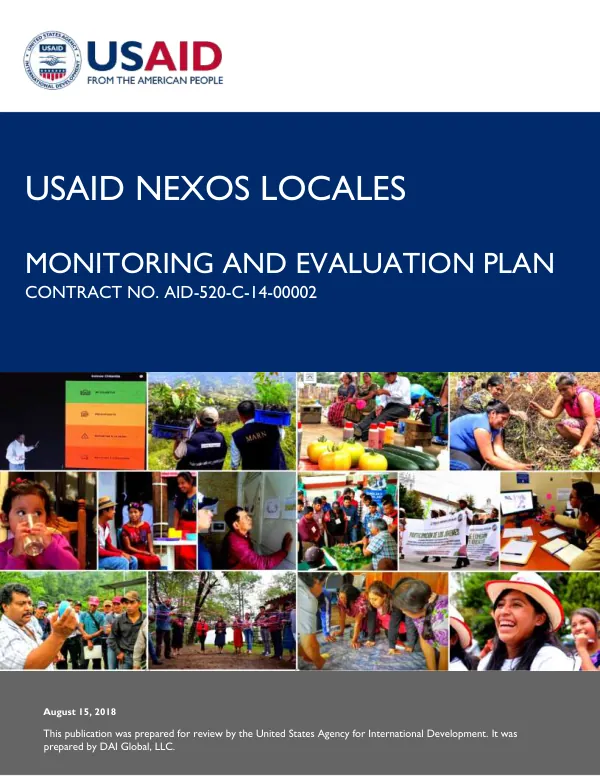
USAID Nexos Locales Monitoring and Evaluation Plan
The USAID Nexos Locales project is an eight-year initiative that began in June 2014, with the primary goal of strengthening municipalities in the Western Highlands of Guatemala to foster more responsive, inclusive, and effective socio-economic development while reducing local vulnerabilities such as food insecurity and natural disasters.
2018 · 81 pages
Sign in to readA free account is required to download.
Abstract
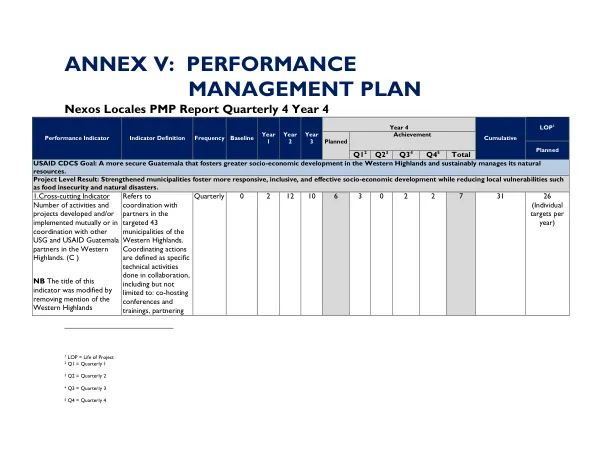
The project contributes to USAID Guatemala's three primary development objectives: 1) Greater security and justice for citizens; 2) Improved levels of economic growth and social development in the Western Highlands; and 3) Improved management of natural resources to mitigate the impacts of global climate change. The project focuses on the departments of Huehuetenango, San Marcos, Quetzaltenango, Totonicapán, and Quiché, and concentrates activities around the needs of agriculture, health, and educational programming. Nexos Locales works collaboratively with local stakeholders, including community-based organizations, civil society organizations, and government institutions, to design and implement activities that address the needs of the target population. The project uses Monitoring and Evaluation (M&E) data to inform programming decisions, and the diagnostics and assessments conducted in Year I and Year 4 provided the baselines for Nexos Locales M&E plan and serve as the foundation for Nexos Locales' evidence-based approach to activity design and implementation. The M&E plan for Year 5 contains 29 indicators, of which 13 are USAID's Standard Foreign Assistance (F) Indicators, and 16 are Customized Indicators (C). The indicators measure the impact of the project that is directly attributable to USG assistance, and directly measure the impact of six intermediate Results, taking into account the cross-cutting themes that are disaggregated to have a dual purpose. The indicators measure areas of assistance on public finances, civil society, institutional strengthening, local economic development, food security, water management, and climate change, while measuring the involvement and strengthening of women, indigenous, and youth. The project's M&E plan is guided by the principles of automated directive systems (ADS) 203, which promote learning, evaluation, and monitoring. The plan is used to identify and address gaps in the evidence base through collaborative analysis of available information and when necessary, conducting special studies, assessments, and surveys. The plan also ensures and refines routine data collection, analysis, and review to inform programmatic decisions. The project's geographic focus is on the Western Highlands of Guatemala, and the methodology involves working collaboratively with local stakeholders to design and implement activities that address the needs of the target population. The project's M&E activities include data collection practices, data quality, and responsibilities, which are outlined in the Performance Management Matrix and Performance Indicator Reference Sheets (PIRS).