SAVE THE CHILDREN FUND
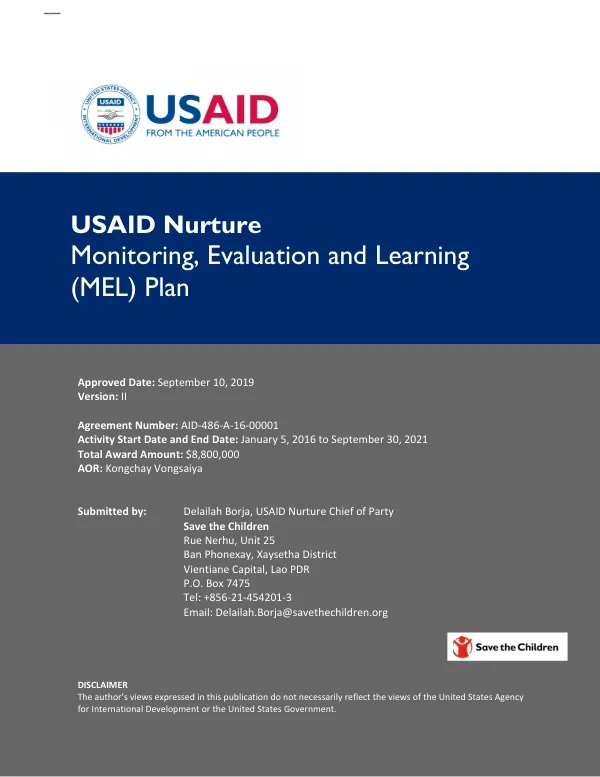
USAID Nurture MEL Plan
The USAID Nurture activity aims to contribute to a reduction in young child stunting in targeted areas of Laos by improving infant and young child feeding (IYCF) and water, sanitation, and hygiene (WASH) practices.
2019 · 79 pages
Sign in to readA free account is required to download.
Abstract
The Activity focuses on improving nutrition and WASH practices targeting the first 1,000 days households, which include households with pregnant women and/or children up to two years of age. The Activity utilizes interpersonal communication through household-level support and links women and children with improved health services. The Activity's approach is based on a modified community-led total sanitation (CLTS) approach integrating nutrition. Communities will be mobilized to appraise and analyze their own nutritional and WASH practices, and to develop and implement plans to improve these practices. The Activity will also provide support to the Government of Lao PDR to build capacity and strengthen multi-sectoral coordination, planning, and budgeting, particularly at provincial and district levels. The USAID Nurture Activity's Theory of Change is based on the assumption that improved IYCF and WASH practices will lead to better nutrition outcomes for young children. The Activity's results framework includes several intermediate results (IRs), including improved IYCF and WASH practices, increased use of quality nutrition and WASH services/facilities, and an enabling environment for improved nutrition through Government of Lao PDR capacity building and strengthening multi-sectoral coordination, planning, and budgeting. The Activity will be monitored and evaluated using a variety of tools and methods, including household surveys, focus group discussions, and routine data quality assessments. The Activity will also conduct special studies and research to provide additional information on the effectiveness of the Activity's interventions. The MEL plan provides a comprehensive overview of the Activity's monitoring, evaluation, and learning approach, including the various tools to be used, a plan for data quality assurance, and a detailed description of the indicators that will measure the Activity's progress towards meeting its objective and reaching all targets. The Activity's learning agenda includes several learning questions, such as "What are the most effective ways to improve IYCF and WASH practices in targeted areas of Laos?" and "How can the Activity best support the Government of Lao PDR to build capacity and strengthen multi-sectoral coordination, planning, and budgeting?" The Activity will use a variety of learning activities, including workshops, training sessions, and research studies, to answer these questions and to inform the Activity's interventions. The USAID Nurture Activity's MEL plan is linked to the Activity's work plan through the goal, strategic objective (SO), intermediate results (IR), and sub-IRs. The plan provides an overview of the processes, specific indicators, and learning agenda used to measure the IRs. The Activity's MEL plan is a critical component of the Activity's overall strategy, and will be used to inform the Activity's interventions and to measure progress towards meeting its objective and reaching all targets. The Activity's focus is on improving nutrition and WASH practices targeting the first 1,000 days households, which include households with pregnant women and/or children up to two years of age. The Activity will utilize interpersonal communication through household-level support and links women and children with improved health services. The Activity's approach is based on a modified community-led total sanitation (CLTS) approach integrating nutrition, and will provide support to the Government of Lao PDR to build capacity and strengthen multi-sectoral coordination, planning, and budgeting, particularly at provincial and district levels. The Activity's results framework includes several intermediate results (IRs), including improved IYCF and WASH practices, increased use of quality nutrition and WASH services/facilities, and an enabling environment for improved nutrition through Government of Lao PDR capacity building and strengthening multi-sectoral coordination, planning, and budgeting. The Activity will be monitored and evaluated using a variety of tools and methods, including household surveys, focus group discussions, and routine data quality assessments. The Activity will also conduct special studies and research to provide additional information on the effectiveness of the Activity's interventions.