ACTION AGAINST HUNGER
USAID-OFDA Disaster Risk Reduction - West and North Africa Fact sheet #1, FY 2011
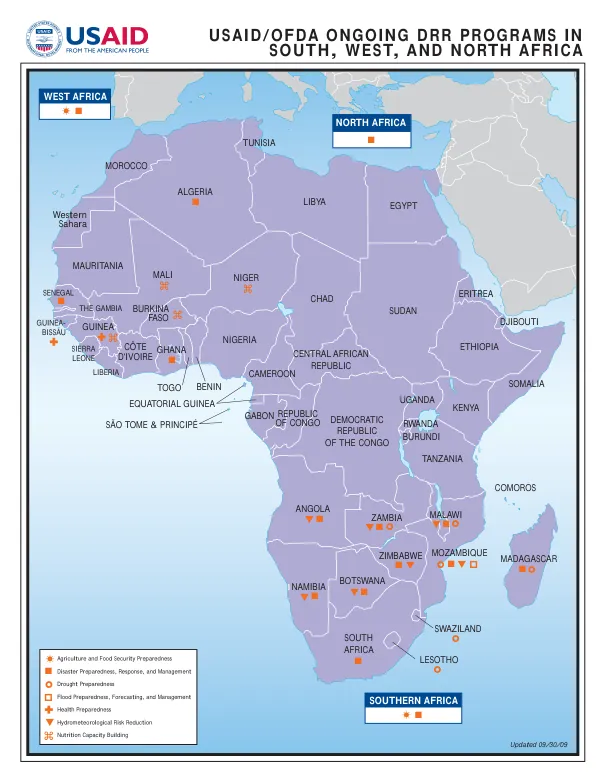
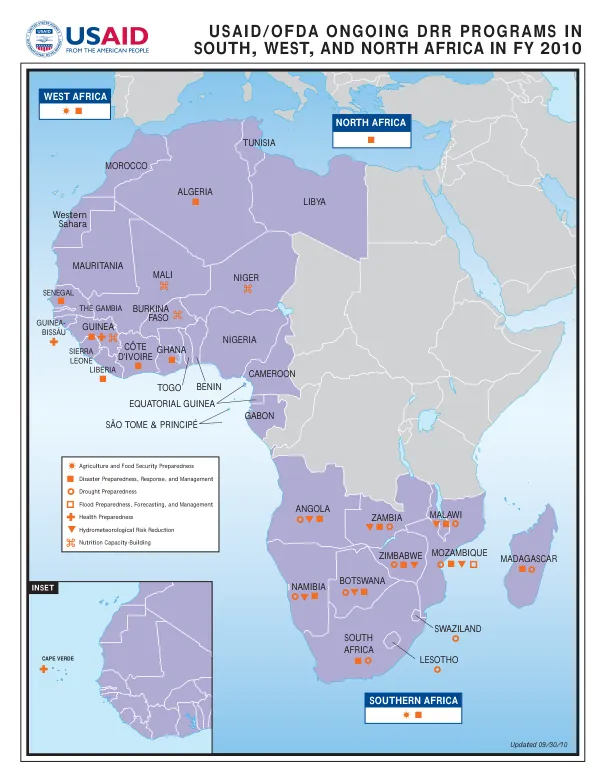
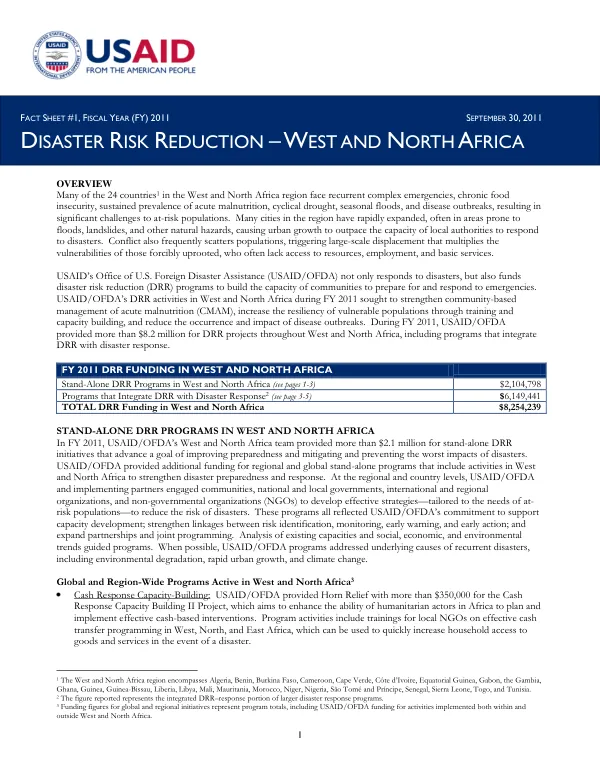
The West and North Africa region encompasses 24 countries, including Algeria, Benin, Burkina Faso, Cameroon, Cape Verde, Côte d'Ivoire, Equatorial Guinea, Gabon, the Gambia, Ghana, Guinea, Guinea-Bissau, Liberia, Libya, Mali, Mauritania, Morocco, Niger, Nigeria, São Tomé and Príncipe, Senegal, Sierra Leone, Togo, and Tunisia.
2011 · 6 pages
Sign in to readA free account is required to download.
Abstract
Many of these countries face recurrent complex emergencies, chronic food insecurity, sustained prevalence of acute malnutrition, cyclical drought, seasonal floods, and disease outbreaks, resulting in significant challenges to at-risk populations. Rapid urban growth in the region has outpaced the capacity of local authorities to respond to disasters, and conflict frequently scatters populations, triggering large-scale displacement that multiplies the vulnerabilities of those forcibly uprooted. USAID's Office of U.S. Foreign Disaster Assistance (USAID/OFDA) responds to disasters and funds disaster risk reduction (DRR) programs to build the capacity of communities to prepare for and respond to emergencies. During FY 2011, USAID/OFDA provided more than $8.2 million for DRR projects throughout West and North Africa, including programs that integrate DRR with disaster response. Stand-alone DRR programs in the region received $2.1 million in funding, while programs that integrated DRR with disaster response received $6.1 million. The total DRR funding in West and North Africa for FY 2011 was $8.2 million. USAID/OFDA's DRR activities in West and North Africa during FY 2011 sought to strengthen community-based management of acute malnutrition (CMAM), increase the resiliency of vulnerable populations through training and capacity building, and reduce the occurrence and impact of disease outbreaks. The agency engaged communities, national and local governments, international and regional organizations, and non-governmental organizations (NGOs) to develop effective strategies to reduce the risk of disasters. In West Africa, USAID/OFDA supported several regional programs, including Cross-Border Cholera Preparedness and Prevention, Food Security and Market Analysis, and Integrating the Surveillance, Treatment, and Prevention of Childhood Acute Malnutrition. The agency also funded country-specific programs in Burkina Faso, Guinea, and other countries to strengthen the skills of local health workers, enhance cholera preparedness capacity, and improve nutrition early warning systems. In Burkina Faso, USAID/OFDA provided more than $650,000 to Helen Keller International (HKI) to improve systematic screenings and quality of care for malnourished children. In Guinea, the agency provided nearly $300,000 to HKI to enhance the nutrition and food security surveillance system, resulting in more timely information for the Government of Guinea, donors, and humanitarian agencies to identify and respond to acute malnutrition. Overall, USAID/OFDA's DRR activities in West and North Africa during FY 2011 aimed to build the capacity of communities to prepare for and respond to emergencies, reduce the occurrence and impact of disease outbreaks, and strengthen the resiliency of vulnerable populations.