USAID DEC
USAID/OFDA Semi-Annual Performance Report: Hurricane Dorian: Multi-Sector Emergency Response to Critical Needs in the Bahamas
Sign inMINISTRY OF HEALTH
USAID/OFDA Semi-Annual Performance Report: Hurricane Dorian: Multi-Sector Emergency Response to Critical Needs in the Bahamas
Hurricane Dorian made landfall in the northernmost islands of the Bahamas on September 1, 2019, as a Category 5 hurricane.
2020 · 13 pages
Sign in to readA free account is required to download.
Abstract
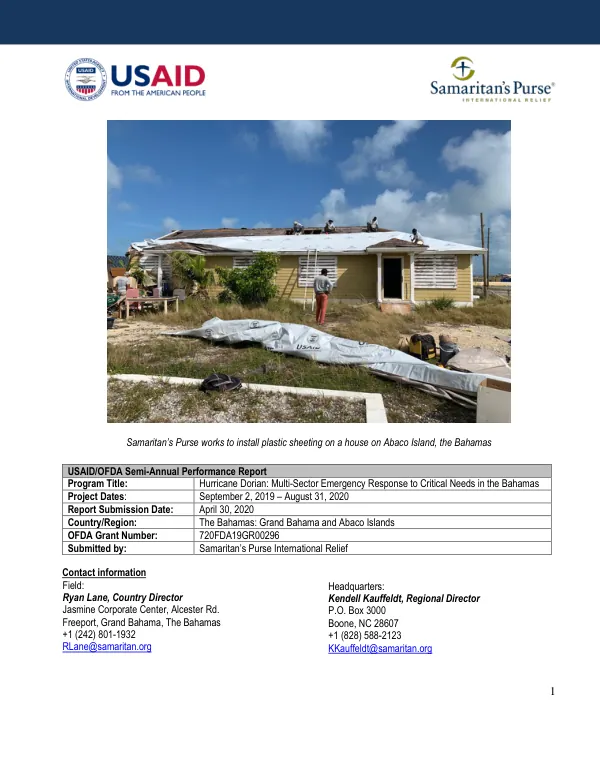
The storm's sustained winds of up to 185 mph caused catastrophic damage across Abaco Islands and the storm surge flooded vast portions of Grand Bahama Island. The water level reached 23 feet high in some areas, higher than the average Bahamian home. The disaster crippled infrastructure, including the health care system on Grand Bahama, thousands of residential houses, and water systems across both islands. Samaritan's Purse began its multi-sectoral emergency response on September 4, 2019, seeking to save lives and reduce suffering through the delivery of critical health, shelter, and water, sanitation, and hygiene (WASH) activities. The organization implemented strategies for protection mainstreaming by conducting formal trainings for all employees on its Code of Conduct, Protection and Safeguarding Policy, and Prevention against Sexual Exploitation and Abuse (PSEA) Policy. Protection Officers on both islands helped to develop and integrate additional strategies within each sector and established a formal complaints mechanism through a confidential hotline. By September 10, 2019, Samaritan's Purse had opened an Emergency Field Hospital (EFH) in Freeport, Grand Bahama, providing the island with crucial health care services and essential medicines. The EFH was fully staffed, operated, and managed by Samaritan's Purse personnel until the local Rand Memorial Hospital (RAND) was able to take on these responsibilities. The handover process took place gradually, beginning in late October 2019 and ending on March 9, 2020, benefiting a total of 6,560 individuals. Samaritan's Purse also implemented a rapid shelter intervention to support affected populations through the construction of transitional shelters. However, following key informant interviews, an island-wide household survey, and consultation with the government, the organization contextualized and adapted shelter activities to better align with the needs presented. Shelter teams began implementing the adjusted activities in November 2019, installing plastic sheeting on roofs, gutting the damaged interior of houses, conducting mold suppression, and restoring minimum interior drywall. Through March, shelter teams managed to work on 418 unique households, benefiting an estimated 1,672 individuals. In response to immediate water supply needs on both islands, Samaritan's Purse WASH teams installed water distribution points, providing potable water to affected populations amidst distribution network repairs. The organization also provided WASH Non-Food Item (NFI) kits inclusive of hygiene messaging materials on Abaco and facilitated debris removal and vector control environmental health activities to communities on Grand Bahama, Abaco, and Elbow Cay. Through all WASH sub-sector activities, Samaritan's Purse supported 7,611 individuals with critical WASH needs. The project experienced some initial delays in implementation due to context-specific challenges, such as a lack of qualified contractors, restrictive government requirements, or the slow restoration of public infrastructure. To complete planned shelter and WASH activities, Samaritan's Purse requested and received a no-cost extension to continue programming through August 31, 2020. The global outbreak of coronavirus disease 2019 (COVID-19) required further adaptations in the implementation of WASH and shelter activities, and the organization continues to respond to needs in the Bahamas amidst the pandemic.