HUMANITY AND INCLUSION
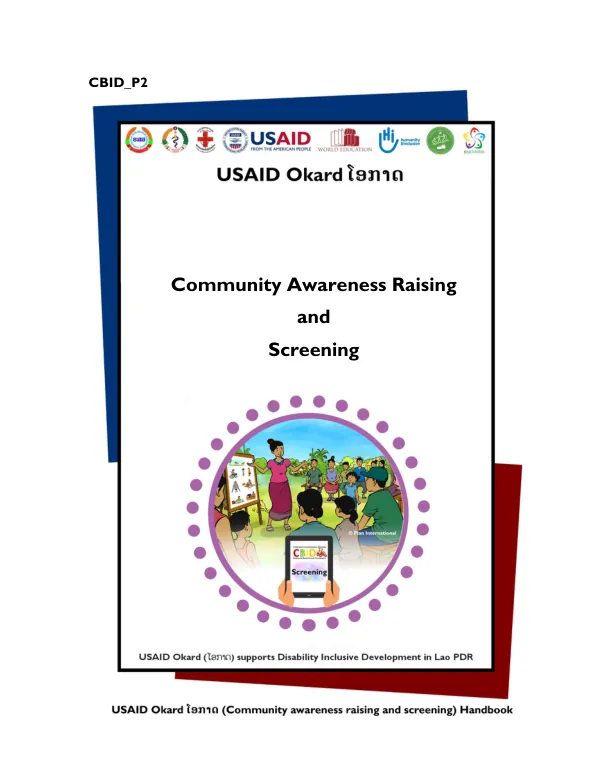
USAID Okard Activity: Community Awareness Raising and Screening
The USAID Okard Activity is a five-year project funded by the U.S.
2021 · 99 pages
Sign in to readA free account is required to download.
Abstract
Agency for International Development (USAID) aimed at improving and sustaining the independent living and functional ability of persons with disabilities and their households in the Lao People's Democratic Republic. The Activity partners with the Lao government, civil society organizations, and the private sector to develop and implement national disability-inclusive policies. The project focuses on promoting equal access to health and related rehabilitation, economic opportunities, and social services in Vientiane Capital and the provinces of Xieng Khouang and Savannakhet. To ensure long-term sustainability, USAID Okard uses a systems-centered approach by focusing on government ownership of disability-inclusive policies and rehabilitation services. The project also applies a person-centered approach through case management to address the individual needs of persons with disabilities and their communities. The Activity works towards creating an environment in which persons with disabilities are empowered to actively participate in society. The anticipated outcomes include improved access to health and rehabilitation services, strengthened health systems, increased employment or self-employment among persons with disabilities and their households, and a more supportive and inclusive environment for the sustainability of health and economic empowerment improvements. The USAID Okard Activity places great importance on training and capacity building, which will be operationalized through the Training Unit headed by a Training and Capacity Building Coordinator. The training unit will oversee all training and capacity building development and implementation by USAID Okard, primarily in three main areas: capacity building for government ministries and service providers, targeted capacity building for sub-recipients, and training and ongoing capacity building for Community Based Inclusive Development (CBID) teams. The CBID Demonstration Model is an evidence-based approach that includes two key components – case management and community mobilization. The CBID teams will directly support persons with disabilities to identify barriers to their economic self-sufficiency and optimal functioning, and work with families, communities, local authorities, and relevant service providers to remove barriers and meet these needs. To effectively implement the CBID demonstration, CBID team members need to have the appropriate knowledge, attitudes, skills, and behaviors focused on five core competencies: practicing with professionalism, practicing in an ethical manner, using critical thinking and professional judgment, embracing and respecting human diversity, and advancing the rights of persons with disabilities. By acquiring and mastering these competencies, the CBID team will be competent to engage in an ongoing, interactive process with persons with disabilities, their families, the community, local authorities, and organizations on sustainable disability inclusion development.
Related documents
Documents in this collection
 2021
2021USAID DEC
USAID Okard Activity: Improving and Sustaining Independent Living and Functional Ability of Persons with Disabilities in the Lao People’s Democratic Republic
Open record 2021
2021USAID DEC