THE LOUIS BERGER GROUP, INC.
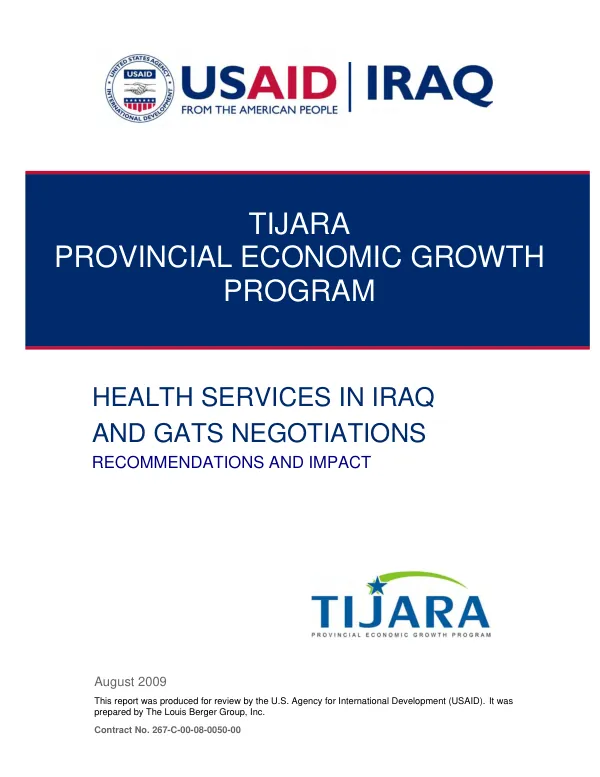
Health Services in Iraq and GATS Negotiations
The General Agreement on Trade in Services (GATS) negotiations are a critical component of Iraq's accession to the World Trade Organization (WTO).
2009 · 51 pages
Sign in to readA free account is required to download.
Abstract
The purpose of this document is to prepare the Government of Iraq (GOI) for the submission of the services chapter to the WTO and to assist the GOI in understanding the context in which each sub-sector operates in the economy. The document is part of a series of reports on various sub-sectors under services, with the goal of facilitating serious economic reform through WTO accession. The GATS framework provides a lens through which the Iraqi Government Services Committee should consider in the analysis of their sector. The framework includes the WTO modes, horizontal commitments, and value chain underpinning the essence of preparation and impact analysis. The document highlights the importance of understanding the context in which each sub-sector operates in the economy, including the regulatory environment, data, and the role of the private sector in WTO negotiations. The health services sector is a significant component of the Iraqi economy, with a substantial economic potential. The sector is comprised of various sub-sectors, including hospital services, other human health services, social services, medical and dental services, veterinary services, and services provided by midwives, nurses, physiotherapists, and paramedical personnel. The sector is regulated by the Ministry of Health (MOH) and is subject to various laws and regulations. The document provides a detailed analysis of the health services sector in Iraq, including its regulatory environment, data, and the role of the private sector. The analysis highlights the importance of liberalization and regulation in the sector, as well as the need to consider linkages between health liberalization and other trade policy issues. The document also discusses the impact of GATS/health services on Iraq, including economic, social, and environmental impacts. The study has been prepared as a background paper supporting Iraq's accession to the WTO and is part of an extensive consultation process involving the GOI Services Committee, civil society, and trade negotiators from Iraq. The document will be presented at various meetings of the GOI Services Committee and will be used to inform the negotiation of offers/commitments for Trade in Goods and for Trade in Services. The health services sector in Iraq faces several challenges, including a lack of infrastructure, inadequate human resources, and limited access to healthcare services. The sector is also subject to various regulations and laws, including the Iraqi Private Hospitals Law and the Iraqi Medical Law. The document highlights the need for the GOI to consider these challenges and to develop strategies to address them in the context of GATS negotiations. The document provides several recommendations for Iraq in the negotiations of the health services sector, including the need to liberalize the sector, to regulate it effectively, and to consider linkages between health liberalization and other trade policy issues. The document also highlights the importance of considering the impact of GATS/health services on Iraq, including economic, social, and environmental impacts. In conclusion, the health services sector in Iraq is a critical component of the country's economy, with a substantial economic potential. The sector is subject to various regulations and laws, and faces several challenges, including a lack of infrastructure, inadequate human resources, and limited access to healthcare services. The document provides a detailed analysis of the sector and highlights the need for the GOI to consider these challenges and to develop strategies to address them in the context of GATS negotiations.