USAID DEC
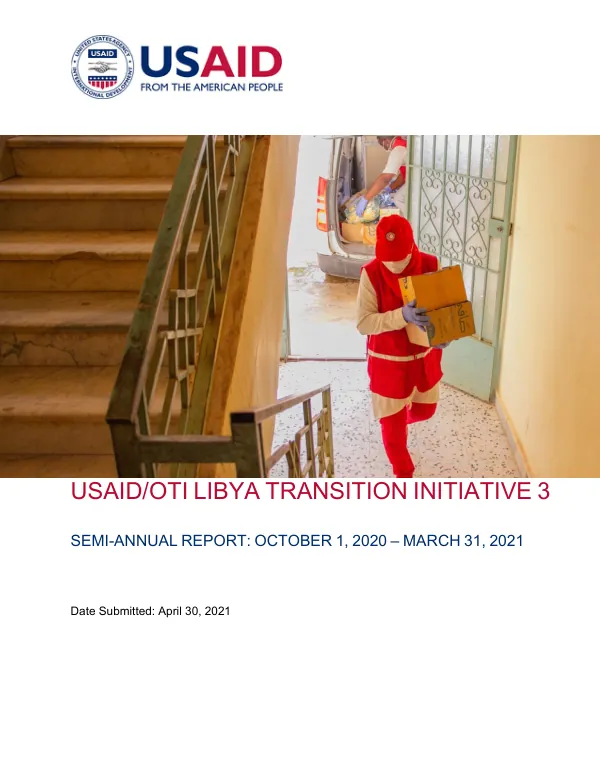
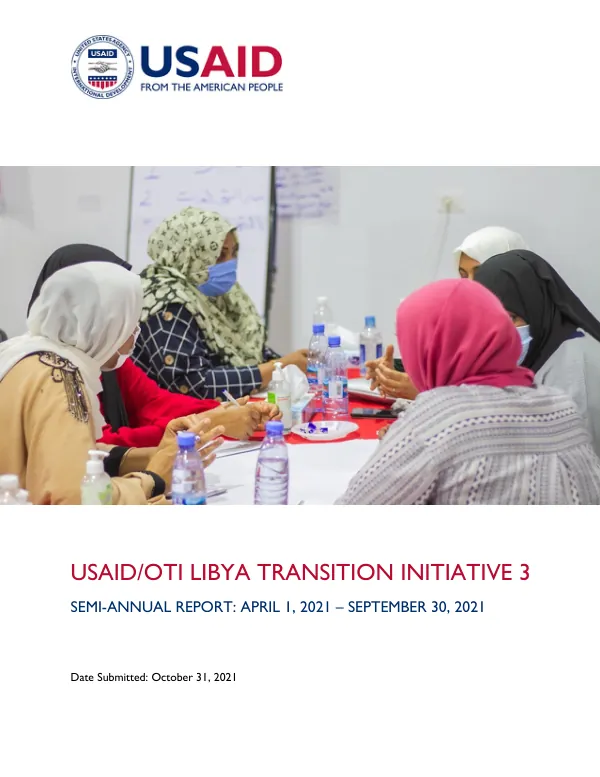
USAID/OTI LIBYA TRANSITION INITIATIVE 3 SEMI-ANNUAL REPORT: APRIL 1, 2021 – SEPTEMBER 30, 2021
Sign inUSAID DEC
USAID/OTI LIBYA TRANSITION INITIATIVE 3 SEMI-ANNUAL REPORT: APRIL 1, 2021 – SEPTEMBER 30, 2021
The Libya Transition Initiative 3 (LTI 3) is a follow-on program launched by USAID's Office of Transition Initiatives in 2017 to support Libya's resilience to fragmentation and security conditions.
2021 · 19 pages
Sign in to readA free account is required to download.
Abstract
The program aims to maintain stability in strategic areas, preserve civilian institutions, and promote a positive political transition. LTI 3 worked towards four objectives: stability in strategic areas, civilian institutions, moderate-led compromise, and support for local and international stakeholders. During the reporting period, LTI 3 implemented 52 activities totaling $19,360,196.81 in 13 municipalities across Libya. Key results include providing technical and material assistance to institutions preparing for December 2021 elections, capitalizing on the momentum for transition by supporting civil society organizations, and addressing public frustration with national and local institutions. The High National Elections Commission (HNEC) launched voter registration in June, and more than 2.86 million Libyans have registered to vote. However, key issues remain unresolved, resulting in concern that elections may be delayed. The House of Representatives (HoR) and High Council of State (HCS) drafted their own election drafts independently of one another, leading to growing public frustration with the Government of National Unity (GNU). Instability increased on the western coastline, with clashes between SDF/444 and Ghneiwa/SSA forces in September, described as the heaviest since June 2020. The LAAF expanded its deployment in the south, moving troops into Fezzan and closing the Essen border in southern Libya. The GNU looked to increase their presence in the south to support fuel convoys and prevent smuggling. The Islamic State (IS) continues to have a presence in Libya, conducting four attacks against the LAAF and affiliates during the reporting period. Fuel and electricity shortages continued to plague the country, resulting in several protests. Widespread power outages averaged six hours per day in the east, and several schools were forced to close temporarily due to the weather and lack of power. The LTI 3 program operations included grants under contract, short-term technical assistance, and direct distribution of services. The program's geographic focus was on 13 municipalities across Libya, with a total of 52 activities implemented during the reporting period. The program's timeframes were from April 1, 2021, to September 30, 2021, with a total budget of $19,360,196.81. The LTI 3 program's recommendations included increasing support for civil society organizations, promoting a positive political transition, and addressing public frustration with national and local institutions. The program's midterm evaluation showed a 27% increase in income among program participants compared to the control group.
Related documents