USAID DEC
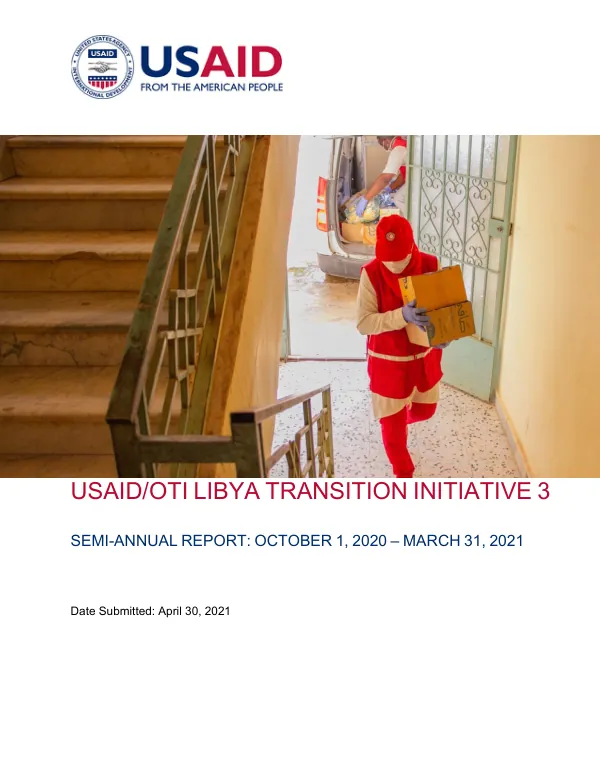
USAID/OTI LIBYA TRANSITION INITIATIVE 3 SEMI-ANNUAL REPORT: OCTOBER 1, 2020 – MARCH 31, 2021
Sign inCHEMONICS
USAID/OTI LIBYA TRANSITION INITIATIVE 3 SEMI-ANNUAL REPORT: OCTOBER 1, 2020 – MARCH 31, 2021
The Libya Transition Initiative 3 (LTI 3) is a program launched by USAID's Office of Transition Initiatives (OTI) in May 2017 to support Libya's resilience to fragmentation and spoilers.
2021 · 21 pages
Sign in to readA free account is required to download.
Abstract
The program utilizes a quick-response mechanism to implement activities nationwide aimed at preventing further deterioration in political and security conditions, and keeping the space open for civilian leadership, reconciliation, and a positive political transition. During the reporting period from October 1, 2020, to March 31, 2021, LTI 3 worked toward several objectives, including maintaining stability in strategic areas, preserving civilian institutions that provide an alternative to military actors, strengthening momentum for moderate-led compromise, and supporting positive efforts by other local and international stakeholders. The program conducted 47 activities totaling $21,177,080.73 in 13 municipalities across Libya. Key results during the reporting period include supporting grassroots and local government-led efforts aimed at post-conflict recovery in South Tripoli, using social media to exert pressure and create public demand for reopening the Sirte-Misrata coastal road, and strategic refocus to support the political momentum resulting from the formation of the Government of National Unity (GNU). The program also conducted a series of virtual strategy sessions as part of a February 2021 Rolling Assessment aimed at updating context analysis and identifying windows of opportunity for programming. The country context during the reporting period was marked by ongoing conflict and instability, with forces on both sides continuing active fighting in Libya, particularly along the Sirte-Al Jufra frontline. The ceasefire signed in October 2020 was not fully respected, and foreign forces continued to support various Libyan factions. The UN continued to call for the withdrawal of foreign forces, which remains a key issue and source of instability. The Libya Political Dialogue Forum (LPDF) talks were initiated in November 2020 under the guidance of the United Nations Support Mission in Libya (UNSMIL), with the main aims of determining a unified governance framework and planning for national elections. The LPDF agreed to hold national elections on December 24, 2021, and selected a unified executive authority in January 2021. Several other political negotiation tracks progressed in parallel with the LPDF, including the Joint Military Commission (JMC) talks and Constitutional Committee discussions. The GNU took over from the GNA on March 16, 2021, with a top priority of preparing for elections and improving the quality of citizen services, including addressing the dire electricity shortages and responding to the COVID-19 pandemic. The GNU submitted their draft budget of 96 billion dinars to parliament, but it is unclear if the proposed budget will be approved due to Libya's deep budget crisis. Overall, Libyans have high expectations of the new government, which has a daunting list of tasks in front of them within a very short timeframe. Growing instability across Libya in response to shifting power dynamics has been a significant challenge. Tensions between GNA-affiliated militias continued to devolve into armed clashes in greater Tripoli, while the Special Deterrence Force (SDF)-affiliated 444 Brigade has taken on an increasing role in securing the rule of law in the region. In the South, Sabha has seen an increase in crime and several rounds of clashes and kidnapping incidents between the Warfallah and Awlad Suleiman tribes. The LAAF launched Operation Desert Shield in the South to address terrorism, fuel smuggling, and human trafficking.