USAID DEC
USAID|PASCA LMG Nicaragua: Universidad Centroamericana (UCA) Committed to the Response to HIV
Sign inUSAID DEC
USAID|PASCA LMG Nicaragua: Universidad Centroamericana (UCA) Committed to the Response to HIV
The Universidad Centroamericana (UCA) is a private university established in Central America in 1960 by the Jesuits.
2016 · 1 pages
Sign in to readA free account is required to download.
Abstract
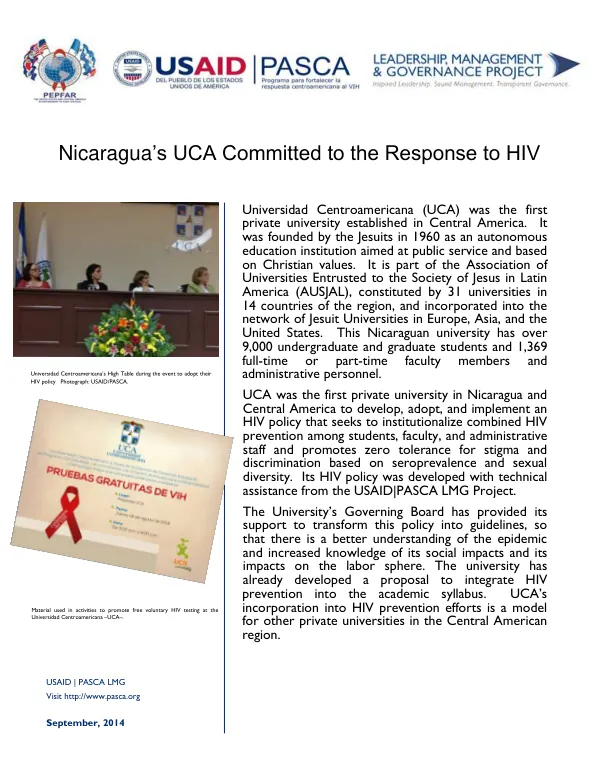
As an autonomous education institution, UCA aims to provide public service based on Christian values. The university is part of the Association of Universities Entrusted to the Society of Jesus in Latin America (AUSJAL), a network of 31 universities in 14 countries, and is also affiliated with the network of Jesuit Universities in Europe, Asia, and the United States. UCA has a large student body, with over 9,000 undergraduate and graduate students, and a faculty and administrative personnel of 1,369 members. UCA has taken a significant step in addressing the HIV epidemic by developing, adopting, and implementing an HIV policy. This policy seeks to institutionalize combined HIV prevention among students, faculty, and administrative staff, and promotes zero tolerance for stigma and discrimination based on seroprevalence and sexual diversity. The policy was developed with technical assistance from the USAID|PASCA LMG Project. The university's Governing Board has provided its support to transform the policy into guidelines, aiming to increase understanding of the epidemic and its social impacts. The university has already made progress in incorporating HIV prevention into its academic syllabus. A proposal has been developed to integrate HIV prevention into the curriculum, which will help to raise awareness and knowledge about the epidemic among students. UCA's incorporation into HIV prevention efforts is seen as a model for other private universities in the Central American region. By taking a proactive approach to addressing the HIV epidemic, UCA is demonstrating its commitment to providing a safe and supportive learning environment for its students. The development of an HIV policy and the incorporation of HIV prevention into the academic syllabus are significant steps towards creating a culture of zero tolerance for stigma and discrimination. This approach will help to promote a better understanding of the epidemic and its social impacts, and will contribute to the reduction of HIV-related stigma and discrimination in the region. By working together with the USAID|PASCA LMG Project, UCA is helping to create a model for other universities to follow in addressing the HIV epidemic. UCA's commitment to addressing the HIV epidemic is a testament to its values of public service and social responsibility. By taking a proactive approach to addressing this critical issue, the university is helping to create a safer and more supportive learning environment for its students, and is contributing to the reduction of HIV-related stigma and discrimination in the region.
Related documents