TETRA TECH
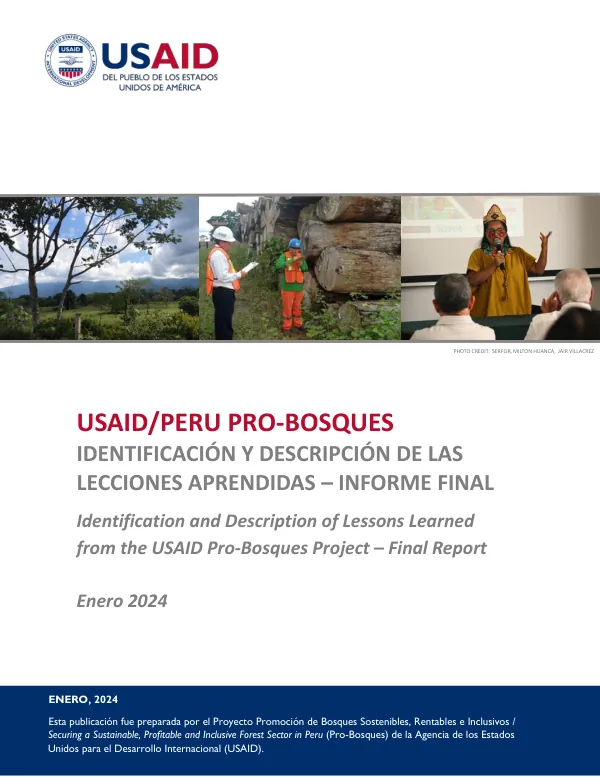
USAID Pro-Bosques – Informe Final de Lecciones Aprendidas
The USAID Pro-Bosques project aimed to promote sustainable, profitable, and inclusive forest management in Peru.
2024 · 77 pages
Sign in to readA free account is required to download.
Abstract
The project began in 2018 and concluded in 2024. The initiative focused on three main components: governance, competitiveness, and social inclusion. Governance component involved strengthening the capacity of the Servicio Nacional Forestal y de Fauna Silvestre (SERFOR) to manage forest resources sustainably. This included the development of a forest management plan, establishment of a forest monitoring system, and training of forest rangers. The project also supported the creation of a forest certification program to promote sustainable forest management practices among small-scale forest producers. The competitiveness component aimed to improve the competitiveness of the forest sector by promoting the use of sustainable forest management practices, improving the quality of forest products, and increasing access to markets. This included the development of a forest products certification program, establishment of a forest products marketing platform, and provision of technical assistance to small-scale forest producers. The social inclusion component focused on promoting the rights and interests of indigenous communities and small-scale forest producers. This included the development of a community forest management plan, establishment of a community forest monitoring system, and provision of training and technical assistance to community forest managers. The project also supported the development of a forest information system, which provided data and information on forest cover, forest products, and forest management practices. This system was used to monitor forest cover changes, track forest products, and identify areas for forest conservation and restoration. The project's results showed significant improvements in forest management practices, forest cover, and forest products. The project also contributed to the development of a more inclusive and sustainable forest sector in Peru. The project's lessons learned and recommendations are expected to inform future forest management initiatives in Peru and other countries. The project's methodology involved a combination of technical assistance, training, and capacity building activities. The project worked closely with government agencies, civil society organizations, and private sector companies to promote sustainable forest management practices and improve the competitiveness of the forest sector. The project's results were evaluated through a combination of quantitative and qualitative methods. The project's impact was assessed through the use of indicators such as forest cover, forest products, and forest management practices. The project's lessons learned and recommendations were developed through a participatory process involving project stakeholders, including government agencies, civil society organizations, and private sector companies. The project's conclusions and recommendations are expected to inform future forest management initiatives in Peru and other countries. The project's lessons learned and recommendations are expected to contribute to the development of a more inclusive and sustainable forest sector in Peru and other countries.
Related documents
Documents in this collection
 2014
2014USAID DEC
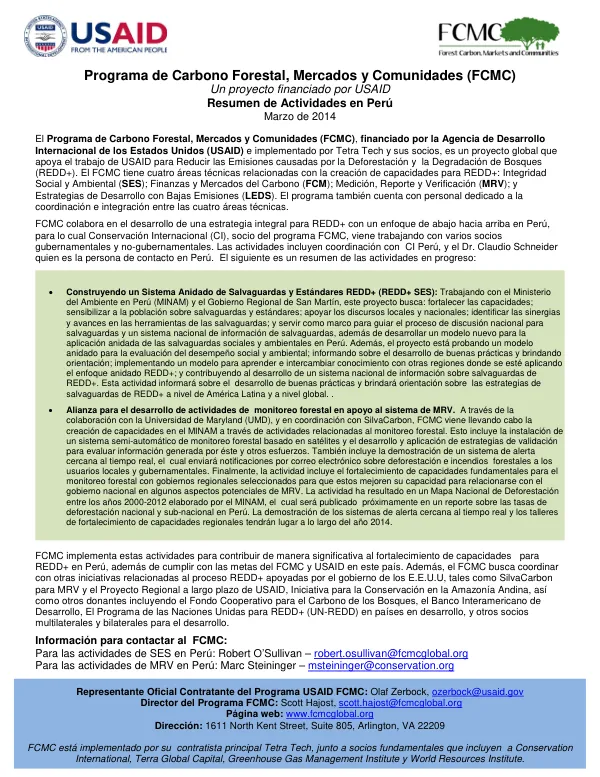
Programa de Carbono Forestal, Mercados y Comunidades (FCMC)
Open record 2013
2013USAID DEC
Sistematización del Marco Normativo y Propuestas para Fortalecer la Participación Ciudadana en el Marco del Plan de Acción de Gobierno Abierto y la Política Nacional de Modernización de la Gestión Pública
Open record