USAID DEC
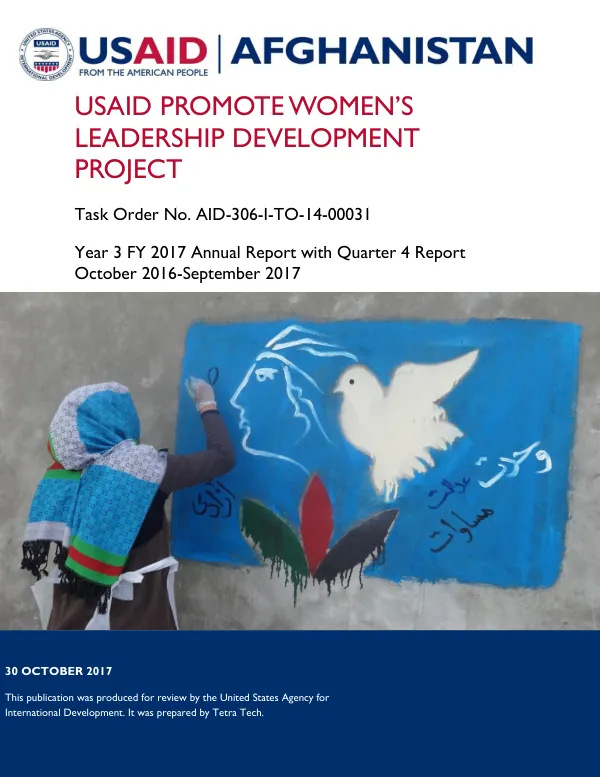
USAID PROMOTE WOMEN'S LEADERSHIP DEVELOPMENT PROJECT Task Order No. AID-306-I-TO-14-00031 Year 3 FY 2017 Annual Report with Quarter 4 Report
Sign inSSG ADVISORS, LLC
USAID PROMOTE WOMEN'S LEADERSHIP DEVELOPMENT PROJECT Task Order No. AID-306-I-TO-14-00031 Year 3 FY 2017 Annual Report with Quarter 4 Report
The Women's Leadership Development (WLD) project in Afghanistan aims to empower women through technical assistance, coaching, training, mentoring, and capacity building.
2017 · 69 pages
Sign in to readA free account is required to download.
Abstract
The project is implemented in five provinces: Kabul, Jalalabad, Mazar-I-Sharif, Kandahar, and Herat, with the potential for outreach to other major population centers in the country. The project targets two groups of women: the Primary Target Group, comprising Afghan women with at least a high school diploma, and the Secondary Target Group, consisting of young, literate Afghan women between the ages of 15 and 24 who have completed primary school but not secondary school. The WLD project focuses on developing management and leadership skills for the Primary Target Group through the "Jawana" curriculum, which facilitates entry and advancement into decision-making positions in social, political, and economic sectors at national, provincial, and district levels. The Secondary Target Group is provided with opportunities to acquire life and work skills through the "Royesh" curriculum, enhancing social and economic development and leadership at the community level. The project relies on several strategies to advance the standing of women in Afghan society, including the creation of a WLD Technical Working Group (TWG) to guide programmatic activities and the development of national curricula for Jawana and Royesh. The project also involves partnerships with international and local organizations, including Afghan Women's Educational Center (AWEC), Netlinks Ltd., and SSG Advisors (SSG). Implementation of the WLD project is managed by Tetra Tech, with assistance from AWEC, Netlinks Ltd., and SSG. The project is funded by the United States Agency for International Development (USAID) under Contract Number AID-306-I-14-00010/AID-306-I-TO-14-00031. The project's overall goal is to empower women in Afghanistan and promote their participation in decision-making positions in social, political, and economic sectors. The project's activities are divided into several components, including communications, gender, scholarships, curriculum implementation and expansion, alumnae development, implementing partner capacity building, knowledge management, partnerships, and monitoring and evaluation. The project's progress is monitored and evaluated through various indicators, including the number of women participating in the project, the number of women completing the Jawana and Royesh curricula, and the number of women advancing into decision-making positions. The project has achieved significant progress in its third year, with over 2,500 women participating in the project and more than 1,500 women completing the Jawana and Royesh curricula. The project has also established partnerships with various organizations, including the Government of the Islamic Republic of Afghanistan (GIRoA), other donor agencies, and local partners. The project's financial report for the third year shows a total expenditure of $1.5 million, with a remaining balance of $500,000. Overall, the WLD project in Afghanistan has made significant progress in empowering women and promoting their participation in decision-making positions in social, political, and economic sectors. The project's continued implementation and expansion will help to advance the standing of women in Afghan society and promote their economic and social development.
Related documents