USAID DEC
USAID Regional Trade Facilitation and Border Management Program (TFB) Communications Plan
Sign inROBERT NATHAN ASSOCIATES
USAID Regional Trade Facilitation and Border Management Program (TFB) Communications Plan
The USAID Regional Trade Facilitation and Border Management Program (TFB) is a five-year activity that aims to enhance Central America's economic integration, particularly in the Northern Triangle (NT).
2018 · 14 pages
Sign in to readA free account is required to download.
Abstract
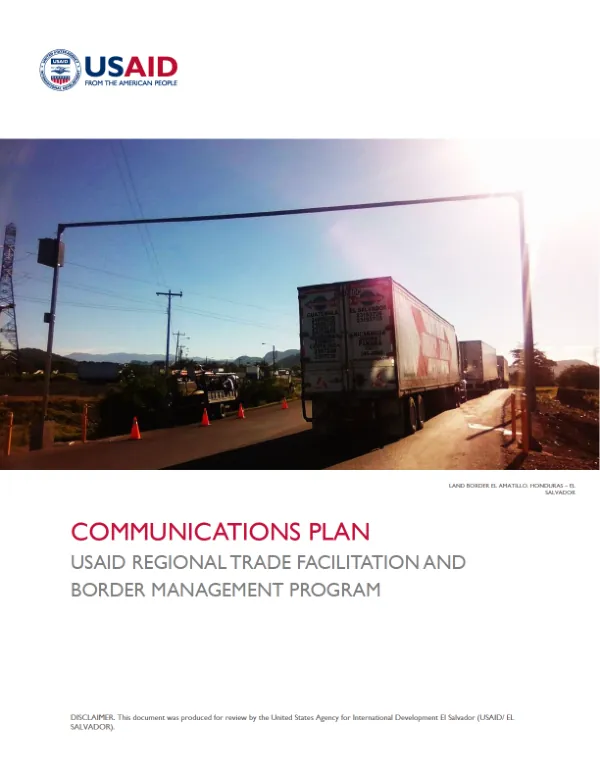
The program, which began on July 25, 2018, and will conclude on July 24, 2023, has two Intermediate Results (IRs): Central America Economic Integration Enhanced, with emphasis on the NT, and Comprehensive Implementation of the World Trade Organization (WTO) Trade Facilitation Agreement (TFA) supported. TFB will build on the progress, relationships, and momentum established under USAID's two predecessor programs: the Regional Trade and Market Alliances Project (RTMA) and the Regional Trade Facilitation Expansion Activity (RTFE). The program will work closely with key border agencies, including Customs, Ministries of Trade, and Sanitary Regulatory Agencies in each country, as well as the Secretary of Central American Economic Integration (SIECA) and the Council of Ministers of Central American Economic Integration (COMIECO). The TFB team will also engage closely with the private sector, including truckers and logistics providers, importers and exporters, and port terminal operators, to strengthen the capabilities of the National Trade Facilitation Committees (NTFCs) in each country. The program will support USAID's overall efforts to facilitate economic growth and stability in the NT and to support the integration strategy of the Central American governments. The communications strategy of TFB is designed to encourage key institutions and target audiences to participate in program interventions, both through direct implementation of activities and by providing stakeholder input that promotes ownership of economic integration efforts. The program will disseminate information to audiences throughout the region under the rubric of a single communications theme: "Families, communities, and entrepreneurs build better lives through participation in the improved trade linkages that enable a growing regional economy." The specific objectives of the communications strategy include promoting uniformity and consistency in communications efforts with USAID's communication strategy and other key USAID programs in the region, ensuring that key stakeholders receive appropriate and timely information on efforts, initiatives, and interventions undertaken by the TFB program, raising awareness of USAID and U.S. Government efforts to support improvement of regional trade capacity and performance in the NT countries, creating awareness among regional and local authorities of the importance to prioritize trade facilitation efforts to increase trade and improve economic competitiveness of the NT countries, and supporting dissemination of trade facilitation initiatives taking place in the region. The TFB activities contribute to increasing employment opportunities, government revenue, regional integration, and economic security in the Northern Triangle region. The program's outreach products will reinforce cross-cutting benefits of program interventions, including reductions in time to trade, reductions in the cost of trade, increasing participation of women in trade, and increasing technical and trade capacity.