CHEMONICS
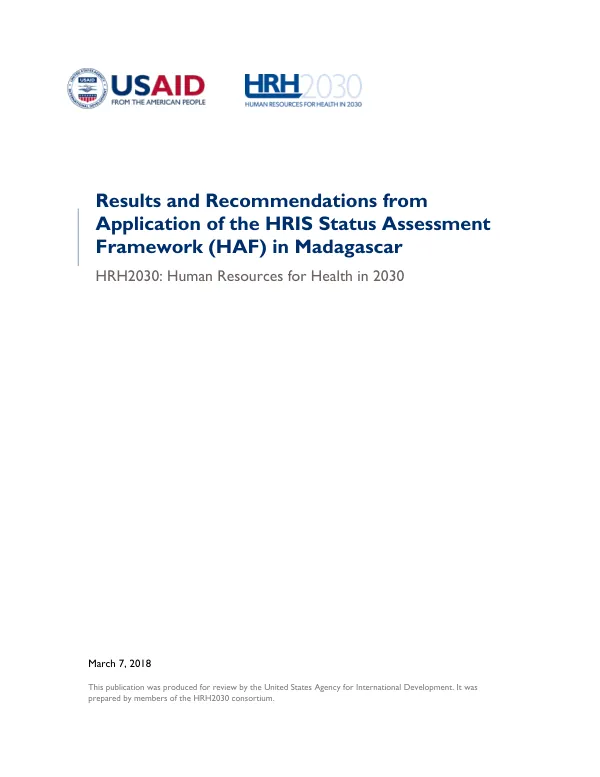
USAID Report: HRIS Assessment Framework (HAF) in Madagascar
The HRIS status assessment aimed to evaluate the new multisectoral HRIS in Madagascar and identify gaps to address during system implementation.
2018 · 35 pages
Sign in to readA free account is required to download.
Abstract
The HRH2030 Program uses the HRIS Assessment Framework (HAF), a tool developed by PEPFAR, to assess both the functionality and capacity of a HRIS. Stakeholders' critical human resources for health (HRH) data needs gathered through HAF inform recommendations to create a more interoperable and effective HRIS. The completion of the Madagascar HAF contributes to the global HAF implementation, providing country comparisons and feedback for the tools' utilization. The availability and use of HRIS data have broad implications, including the delivery of health services related to family planning and HIV. A functional HRIS can assist the Ministry of Health to deploy health workers with the necessary skills to provide key HIV care services. The same concept applies to community health needs, such as those related to family planning (FP) services and maternal and child health care (MCH). The HAF Assessment team gathered HAF data through stakeholder interviews over an eight-day period in September 2017. Stakeholders spanned the Ministry of Health at central and subnational levels, the Ministry of Civil Service, the Ministry of Finance, pre-service education institutions, health professionals' regulatory bodies, professional associations, and partner organizations. The application of the HAF yielded a Functional Strength score of 1.7 and a Capacity Strength score of 2.3, for an overall HRIS Strength score of 2.0 on a scale of 1 to 5. The assessment revealed a host of systems being used to capture HRH data, ranging from Microsoft Excel spreadsheets to Microsoft Access databases. However, no system provided evidence of interoperability or basic exchange. A full-day workshop was held to discuss HRIS policy discussions and roundtable discussions were conducted to deliberate on the topic areas defined by the HAF tool. The workshop aimed to identify gaps and provide recommendations for the implementation of the new multisectoral HRIS in Madagascar. The assessment identified several key areas for improvement, including the need for a more comprehensive HRIS that can capture and analyze HRH data. The HRH2030 Program will use the HAF results to inform recommendations for the implementation of the new HRIS. The program will also work with stakeholders to develop a plan to address the gaps identified in the assessment. The HRH2030 Program will also work with the Ministry of Health to develop a plan to implement the new HRIS and to ensure that the system is interoperable with other health information systems. The program will also provide training and technical assistance to support the implementation of the new HRIS. The HRH2030 Program will also work with stakeholders to develop a plan to address the gaps identified in the assessment. The program will also provide recommendations for the implementation of the new HRIS and will work with the Ministry of Health to develop a plan to implement the new HRIS. The HRH2030 Program will also work with stakeholders to develop a plan to address the gaps identified in the assessment. The program will also provide