USAID DEC
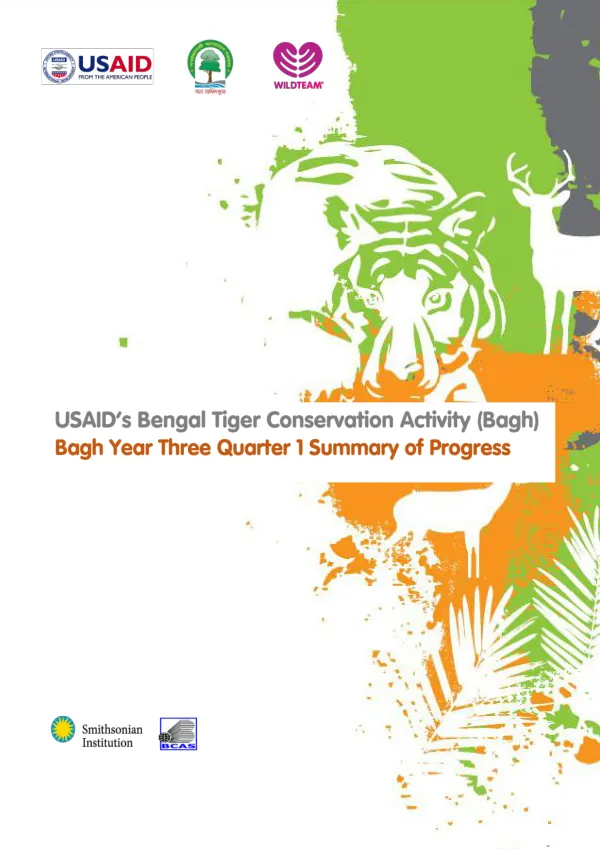
USAID’s Bengal Tiger Conservation Activity (Bagh) Year Three Quarter 1 Summary of Progress
Sign inSMITHSONIAN INSTITUTION
USAID’s Bengal Tiger Conservation Activity (Bagh) Year Three Quarter 1 Summary of Progress
The Bengal Tiger Conservation Activity (Bagh) is a four-year project implemented by WildTeam in partnership with the Forest Department of the Ministry of Environment and Forests, USAID, Smithsonian Institution, and the Bangladesh Centre for Advanced Studies.
2016 · 17 pages
Sign in to readA free account is required to download.
Abstract
The project aims to conserve the Sundarbans and protect the tigers, with the overall goal of conserving biodiversity in Bangladesh. Component 1 of the project, Expanded Knowledge Base, focused on conducting extensive field research in the Sundarbans during the first quarter of 2016. Two teams of researchers conducted a two-month survey of the entire Sundarbans, collecting data on tiger monitoring, prey monitoring, habitat monitoring, water salinity mapping, and DNA-based population monitoring. The research teams also conducted a questionnaire survey in 14 villages to assess the perception of local communities about domestic dogs and their role as disease vectors for tigers. Component 2, Reduced Illegal Wildlife Trafficking, focused on delivering realistic solutions for greater collaboration and enhanced capacity to reduce wildlife trafficking. Two separate trainings were organized for selected Forest Department staff members on Spatial Analysis Skills Training and Basic SMART Patrolling Techniques and Database Management. The project also recommended the use of SAT Phone and Delorme during SMART patrolling in the West Sanctuary, as mobile network is not available in that area. Component 3, Minimized Human-Wildlife Conflicts, aimed to prevent human-wildlife conflict, reduce fatalities, and provide victim relief. Regular village forums and Village Tiger Response Team (VTRT) meetings continued throughout the quarter, with a total of 147 VTRT meetings and 15 leader meetings held in all four ranges. The project also recruited a VTRT sustainability consultant to help execute its VTRT Sustainability Plan. Component 4, Enhanced Communications, Outreach, and Gender Engagement, aimed to address human threats to tigers, wildlife, and the environment by focusing on behavioral change through communications, outreach, and gender engagement. A two-year National Tiger Awareness Campaign and the Tiger Caravan were launched on 11-12 February 2016 to raise mass awareness across the country about the dire situation of Bengal tigers and Sundarbans. The campaign visited around 87 locations in 11 districts and organized 89 shows of the Sundarbans diorama and street drama, reaching nearly 150,000 people. The project also published 13 issues of Tiger Tuesday, a weekly newsletter providing updates and success stories of USAID's Bagh Activity. The Bagh PPP Strategy and Guidelines were approved by the Chief of Party in February 2016, and a Partnership Monitoring Committee and Terms of Reference were developed and approved. The project's Partnership Product Development and Partnership Management System development are ongoing to implement the PPP Strategy. Overall, the first quarter of 2016 was a productive period for the Bagh project, with significant progress made in all four components. The project continues to work towards its goal of conserving biodiversity in Bangladesh and protecting the tigers and Sundarbans ecosystem.