USAID DEC
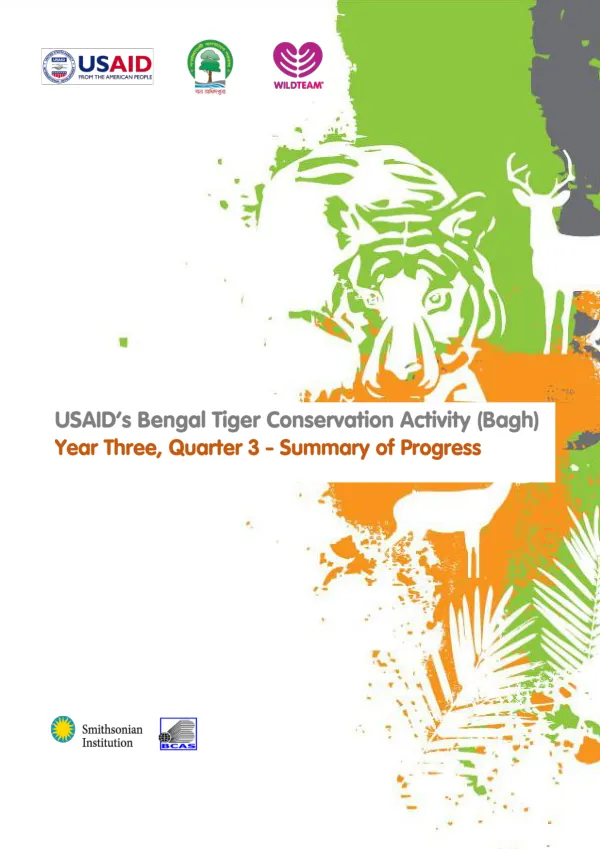
USAID’s Bengal Tiger Conservation Activity (Bagh) Year Three, Quarter 3 - Summary of Progress
Sign inSMITHSONIAN INSTITUTION
USAID’s Bengal Tiger Conservation Activity (Bagh) Year Three, Quarter 3 - Summary of Progress
The Royal Bengal tiger conservation initiative in Bangladesh, known as the USAID's Bengal Tiger Conservation Activity (Bagh), is a four-year project implemented by WildTeam in partnership with the Forest Department of the Ministry of Environment and Forests, USAID, the Smithsonian Institution, and the Bangladesh Centre for Advanced Studies.
2016 · 46 pages
Sign in to readA free account is required to download.
Abstract
The project aims to protect the Royal Bengal tigers and conserve the Sundarbans, with the overall goal of preserving the biodiversity of Bangladesh. The project's third year, third quarter report highlights key accomplishments during the implementation period of 1 July-30 September 2016. The report focuses on three main components: Expanded knowledge base, Reduced illegal wildlife trafficking, and Minimized human-wildlife conflicts. The Expanded knowledge base component involves research activities aimed at improving the understanding of tiger ecology and conservation in the Sundarbans. The Research Team carried out its planned activities this quarter, including preparing four reports based on data collected during fieldwork from December to February. The reports focused on the relative abundance of tigers, occupancy of tigers, relative abundance of tiger prey, and change detection in land cover in Katka-Kachikhali. The team also initiated vegetation sampling data analysis with the help of the Smithsonian Environmental Research Institute (SERC) and obtained a permit to export biological samples of DNA to the Smithsonian Institution for further analysis. The Reduced illegal wildlife trafficking component focused on strengthening the capacity of the Government of Bangladesh and civil society to respond to wildlife trafficking and engage regional and international bodies in the global efforts to prevent wildlife crimes. Activities in the third quarter included conducting SMART patrols, which covered a total of 5,107 km in 696 hours and resulted in the apprehension of 18 offenders and the seizure of 30 boats. The team also provided on-the-job training to Forest Department patrol staff and facilitated a workshop on forensic DNA testing to discuss the possibility of using modern DNA testing options to strengthen wildlife crime prosecutions in Bangladesh. The Minimized human-wildlife conflicts component aimed to prevent human-wildlife conflict, reduce fatalities, and provide victim relief. Activities in the third quarter included holding six Village Tiger Response Team (VTRT) Annual Coordination Meetings to enhance coordination among VTRTs, local administration, Co-management committees, and law enforcement agencies and the Forest Department. The team also included women in the community-led VTRTs for the first time in September, with 14 women volunteers included in five VTRTs in Koira Upazila under a pilot scheme. The project's performance monitoring and evaluation activities were also ongoing, with the Institutional Capacity and Development Team (Team ICT) providing support to the project's implementation. The team also conducted a security assessment, which included all expatriate residences, offices, and hotels that the project uses for accommodation and conference purposes. The assessment provided feedback on certain provisions to put in place, ensured the quality of the apartment and hotel locations, and provided confirmation to counterparts that they may travel to Bangladesh, thus avoiding potential delays in programming in the future. The project's new Area of Responsibility (AOR) from USAID joined during this time, resulting in a brief period of transition. USAID's representatives have since been engaged in project activities and meetings with Forest Department counterparts and other stakeholders. However, there is still uncertainty on long-term visas for all three expatriates, which has been a constant struggle and issue, expending time and resources to try and resolve this issue.