USAID DEC
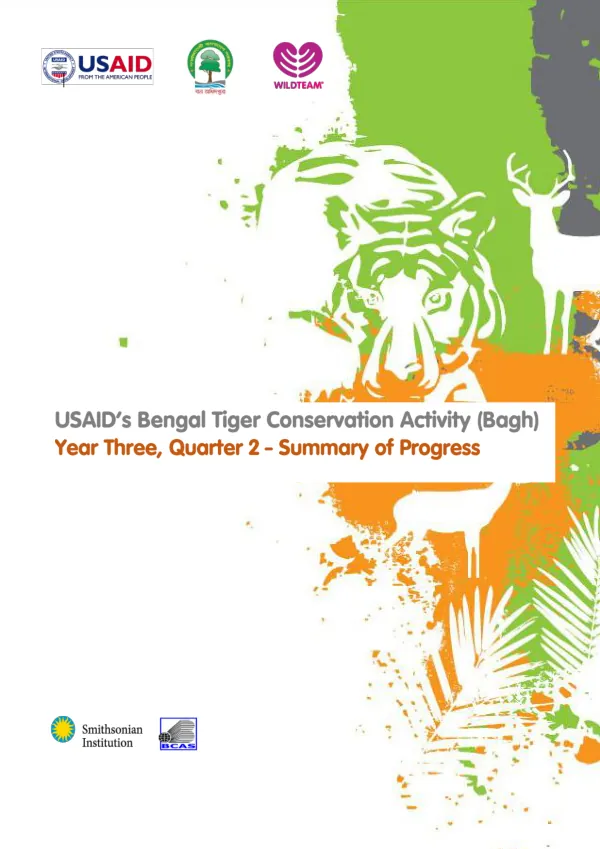
USAID’s Bengal Tiger Conservation Activity (Bagh) Year Three, Quarter 2 - Summary of Progress
Sign inSMITHSONIAN INSTITUTION
USAID’s Bengal Tiger Conservation Activity (Bagh) Year Three, Quarter 2 - Summary of Progress
The Royal Bengal tiger conservation initiative in Bangladesh, known as the Bengal Tiger Conservation Activity (Bagh), is a four-year project implemented by WildTeam in partnership with the Forest Department (FD) of the Ministry of Environment and Forests (MoEF), USAID, the Smithsonian Institution, and the Bangladesh Centre for Advanced Studies.
2016 · 50 pages
Sign in to readA free account is required to download.
Abstract
The project aims to protect the Royal Bengal tigers and conserve the Sundarbans, with the overall goal of preserving the biodiversity of Bangladesh. The project management team, led by the Chief of Party, consolidated around the COP's arrival in the previous quarter. The team addressed an ongoing issue regarding the withholding of the COP's salary for income tax purposes, which was resolved after a meeting at the Prime Minister's Office with Bangladesh Government officials and the Project's AOR. The issue was resolved with an understanding that all non-Bangladeshi staff members are exempt from income taxes. The Technical Implementation Activity, under Component 1, focused on expanding the knowledge base. The Research Team carried out its planned activities, including analyzing data collected during fieldwork in Sundarbans between December 2015 and February 2016. The team also conducted a pilot research study to detect changes in inland cover of the Katka-Kochikhali region of Sundarbans East sanctuary. The FD gave Bagh permission to ship biological samples to the Smithsonian Institution for DNA analysis, and a Memorandum of Understanding (MoU) was signed with Chittagong Veterinary and Science University to collaborate in the area of disease monitoring and epidemiology research. Component 2 focused on reducing illegal wildlife trafficking by strengthening the capacity of the Government of Bangladesh (GoB) and civil society to respond to wildlife trafficking. Activities in Q2 included finalizing a Training Needs Assessment report, preparing a Community Patrol Group (CPG) Operational Guideline, conducting three SMART patrol phases, and purchasing and handing over Delorme devices to the patrolling team. The Law Enforcement Monitoring (LEM) unit conducted two field trips to Satkhira range to gather information on wildlife crime, and the Tiger Hotline received 80 calls, with 12 incidents validated and shared with local FD offices. Component 3 aimed to minimize human-wildlife conflicts by preventing fatalities and providing victim relief. Activities in Q2 included organizing a regional workshop on Village Tiger Response Team (VTRT) sustainability, holding VTRT in-team and social meetings, and conducting capacity development trainings for VTRT members. VTRT members and Community Conservation Action (CAT) staff helped FD and firefighters put out fires in the Chandpai range, and rescued 48 wild animals and successfully released them into the forest. Component 4 addressed human threats to tigers, wildlife, and the environment by focusing on behavioral change through communications, outreach, and gender engagement. Activities in Q2 included holding 158 village forums in 22 wards of all four ranges of Sundarbans, engaging a total of 3,580 local villagers, and drafting a concept note on The BoatChain. The TigerCaravan wrapped up a successful four-month tour, and 'Conservation Hot Topics' were drafted and will be used as a messaging tool in village forums and VTRT meetings.