USAID
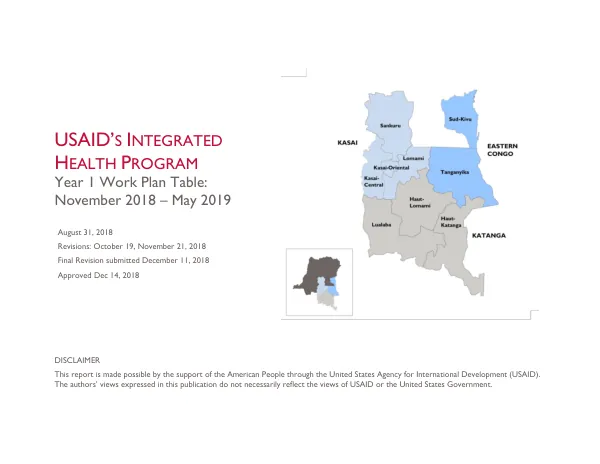
USAID'S INTEGRATED HEALTH PROGRAM Work Plan Table: November 2018 - May 2019
The USAID's Integrated Health Program in the Democratic Republic of Congo aims to strengthen the capacity of Congolese institutions and communities to deliver high-quality, integrated health services for sustainable improvement of the health status of the Congolese population.
2018 · 60 pages
Sign in to readA free account is required to download.
Abstract
The program's goal is to achieve this through the implementation of several objectives, including strengthened health systems, governance, and leadership at provincial, health zone, and facility levels. One of the key objectives of the program is to strengthen health systems, governance, and leadership at provincial, health zone, and facility levels. This objective is further divided into several indicators, including the average Participatory Institutional Capacity Assessment Learning tool (PICAL) score of selected sub-national level health divisions assessed for institutional capacity. The program also aims to enhance the capacity to plan, implement, and monitor services at provincial, health zone, and facility levels through the provision of financial support to technical support visits of national experts. The program also focuses on improving transparency and oversight in health service financing and administration at provincial, health zone, facility, and community levels. This includes organizing coordination meetings with USAID-funded institutions to assess local government entities and creating visualizations in the District Health Information System (DHIS) to assist technical committees at the provincial level in their decision-making processes. Another key objective of the program is to increase access to quality, integrated health services in target health zones. This includes increasing the availability of quality, integrated facility-based health services, such as designing and developing an android application to identify facilities that provide reproductive health and maternal and child health services. The program also aims to increase the availability of quality, integrated community-based health services, such as designing and developing a mobile phone or digital data collection tool for surveys on community-based services sites in targeted health zones. The program also focuses on improving referral systems from community-based platforms to health centers and reference hospitals, as well as improving health provider attitudes and interpersonal skills at facility and community levels. Additionally, the program aims to increase the availability of innovative financing approaches and improve basic facility infrastructure and equipment to ensure quality services. The program's implementation is expected to be carried out through several activities, including providing financial support to technical support visits of national experts, conducting SMS and IVR-based surveys, and designing and developing digital tools for data collection and management. The program also aims to establish quarterly collaboration and coordination meetings involving the District Health System, the Provincial Health System, and USAID IHP to support better use of routine data systems. The program's indicators include several metrics, such as the average PICAL score, the percentage of annual provincial action plans and budgets aligned with national action plans and budgets, and the percentage of annual health zone action plans and budgets aligned with provincial action plans and budgets. The program also aims to achieve several outcomes, including increased access to quality, integrated health services, improved health provider attitudes and interpersonal skills, and increased availability of innovative financing approaches. The program's implementation is expected to be carried out over a period of several months, with several activities and indicators to be achieved during this time. The program's success will be measured through the achievement of its indicators and outcomes, which will be monitored and evaluated regularly to ensure that the program is on track to meet its goals.
Related documents