USAID DEC
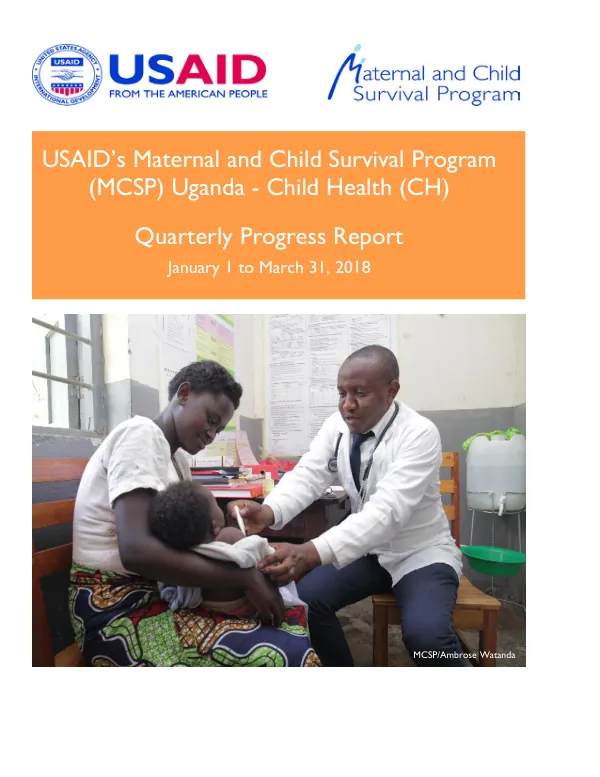
USAID’s Maternal and Child Survival Program (MCSP) Uganda - Child Health (CH) Quarterly Progress Report
Sign inCLINTON HEALTHCARE ACCESS INITIATIVE
USAID’s Maternal and Child Survival Program (MCSP) Uganda - Child Health (CH) Quarterly Progress Report
The Maternal and Child Survival Program (MCSP) is a global U.S.
2018 · 31 pages
Sign in to readA free account is required to download.
Abstract
Agency for International Development (USAID) cooperative agreement to introduce and support high-impact health interventions in 25 priority countries with the ultimate goal of preventing child and maternal deaths. MCSP is currently implementing two programs in Uganda: the Routine Immunization program (MCSP RI) and the Child Health program (MCSP CH). The Child Health program is an eighteen-month technical assistance program to provide tailored support in the area of Child Health (CH) to the USAID's Regional Health Integration to Enhance Services (RHITES) projects in South West (SW) and East Central (EC) regions. The RHITES projects are working with the Government of Uganda to support implementation of the Uganda Reproductive, Maternal, Newborn, Child, and Adolescent Health (RMNCAH) Sharpened Plan, which includes a package of low cost, high impact, evidence-based RMNCAH interventions that can be applied at different levels of the health system to reduce mortality. The expected result of MCSP's tailored technical assistance for CH is implementation of a standardized CH package across the RHITES projects, that determines the costs involved and gathers learning on the feasibility of implementing the package in an integrated way in four demonstration districts (Luuka, Kaliro, Ntungamo, and Sheema), to inform national level CH policy and program updates. During the quarter, MCSP continued assistance to the RHITES implementing partners (IPs) in the EC and SW region to implement a package of essential CH interventions at all levels. Rollout of the Integrated Management of Neonatal and Childhood Illness (IMNCI) at health facility level was completed in all four demonstration districts of Kaliro, Luuka, Ntungamo, and Sheema. This rollout was conducted using two alternative IMNCI training models - Distance Learning (DL) and Short Interrupted Course (SIC) - as agreed with MOH, WHO, and other partners. MCSP is analyzing these experiences to derive recommendations for how the two models can be used to support IMNCI capacity strengthening of frontline health workers (HWs) across the remaining RHITES districts and eventually nationwide. MCSP in collaboration with partners through the Diarrhoea, Pneumonia Coordination Committee (DPCC), developed recommendations to address prolonged stock outs of amoxicillin dispersible tablets (DT). In addition, MCSP supported the MoH CH Division to develop recommendations for the revision of CH indicators in the national Health Management Information System (HMIS). Recommendations to include the revised WHO IMNCI classification for pneumonia, diarrhoea, malnutrition, and the sick young of infant; and an indicator to track stock outs of injectable antibiotics for management of severe disease were adopted during the first round of consultation. Indicators on appropriate treatment for pneumonia, diarrhoea and possible serious bacterial infection, remained pending requiring further discussion. District-wide rollout of the Village Health Team (VHT) package was achieved in RHITES EC demonstration districts (i.e. Kaliro and Luuka), while in the RHITES SW region it was partially completed to bring coverage to about 50% of sub-counties in both demonstration districts (i.e. Ntungamo and Sheema). Also in collaboration with partners, MCSP validated a manual for community-owned resource persons focused on Key Family Care Practices (KFCP) and used the draft manual to identify key messages for promotion of practices at the household level and integrated these messages into the VHT package being rolled out in the four demonstration districts. MCSP supported and demonstrated a district level quarterly review meeting (QRM) for RHITES EC in Luuka District. District specific drafts of the CH score card were piloted during the QRMs to support evidence-based planning at health facility level. MCSP participated in the multi-sectoral workshop for KFCP held in January 2018, where the meeting organized by the MoH, in collaboration with UNICEF, aimed to review, validate, and endorse a community-owned resource manual on KFCP. The manual will act as a resource for training community-based workers on promoting the KFCP at the household level, and also for developing key health education and promotion messages targeting households.