UNITED NATIONS CHILDREN'S FUND
Quarterly Progress Report: April 1st to June 30th, 2015
The USAID's Maternal and Child Survival Project (MCSP) in Uganda is a four-year initiative aimed at strengthening the country's Expanded Program on Immunization (EPI) and improving maternal and child health outcomes.
2015 · 14 pages
Sign in to readA free account is required to download.
Abstract
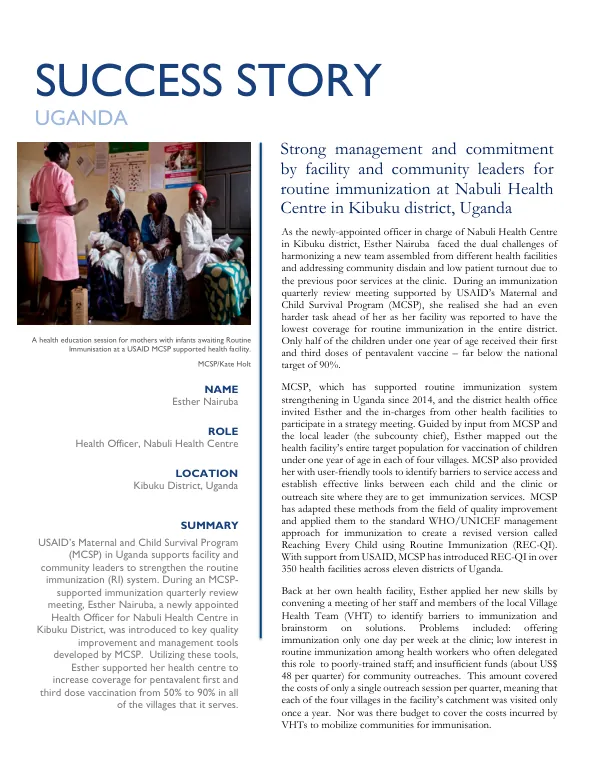
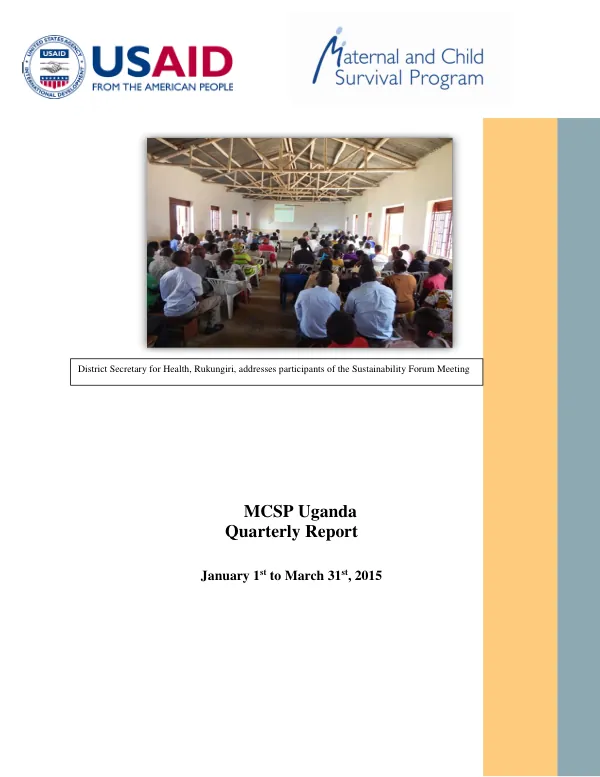
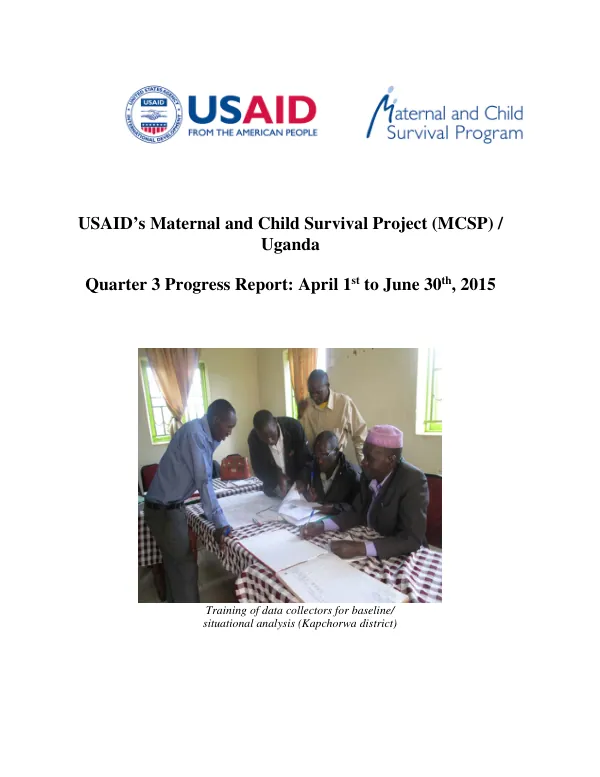
The project, which began in July 2014, is funded by USAID with an obligation of $1,400,000. The project's overall objective is to strengthen UNEPI's institutional and technical capacity to plan, coordinate, manage, and implement immunization activities at the national level. To achieve this objective, the project focuses on capacity building, support, and scaling up the Reaching Every Community using Quality Improvement (REC-QI) approach. The REC-QI approach is a quality improvement strategy that aims to improve immunization coverage and equity by engaging communities and health facilities in the planning and implementation of immunization activities. During the third quarter of 2015 (April 1st to June 30th), the project made significant progress in implementing the REC-QI approach in five MCHIP and two MCSP districts. The project supported Sustainability Forum Meetings in Kabale and Iganga districts, which brought together district and sub-county leaders, health facility in-charges, EPI focal persons, and USAID/MCSP staff to review district RI performance and plan for sustainability. The project also conducted district pre-visits to Kanungu and Butaleja districts, which introduced MCSP to the districts and discussed the REC-QI approach and its potential benefits. In addition to implementing the REC-QI approach, the project also supported the development of training and IEC materials for IPV Introduction in Uganda. The project participated in the National Coordination Committee (NCC) meeting at the Ministry of Health (MOH) and two UNEPI Technical Working Group (TWG) meetings. The project also supported the repair of eight faulty EPI fridges in Kanungu District, which was identified as a challenge hindering RI service delivery. Despite the progress made, the project faced several challenges, including competing priorities at the MOH/UNEPI level, which hindered the review of the Immunization in Practice (IIP) Manual. The implementation of nationwide immunization activities, including IPV introduction and mass measles campaign, was also rescheduled or delayed until September/October 2015. The project will review its implementation plan to accommodate the shifts in these national level activities. The project also identified lessons and best practices from USAID's MCHIP implementation, which were incorporated into the REC-QI 'How to Guide'. The REC-QI How to Guide will be used to support EPI system strengthening in the new MCSP and SS4RI supported districts and beyond by MOH and other partners. The project also shared a success story, which is documented in Annex A. The project's Performance Monitoring Plan (PMP) is currently being updated with baseline data and targets for FY 2014/15. The plan is to share with USAID/Uganda for comments and approval last week of July 2015. The approved PMP will be shared with USAID's monitoring, evaluation and learning (ME&L) advisor for uploading onto the Performance Monitoring and Evaluation (PME) system.