USAID DEC
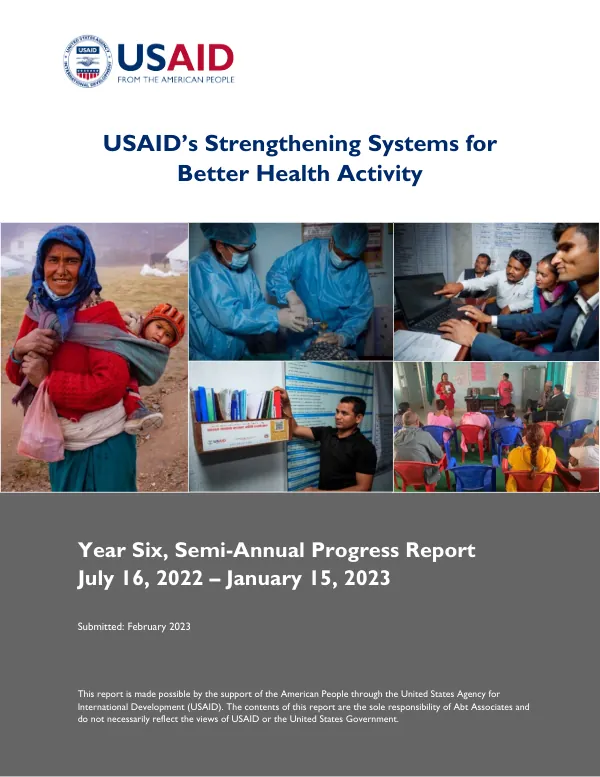
USAID’s Strengthening Systems for Better Health Activity, Year Six, Semi-Annual Progress Report, July 16, 2022 – January 15, 2023
Sign inABT ASSOCIATES
USAID’s Strengthening Systems for Better Health Activity, Year Six, Semi-Annual Progress Report, July 16, 2022 – January 15, 2023
The Strengthening Systems for Better Health Activity in Nepal began in January 2018 with the goal of improving health outcomes, particularly for marginalized and disadvantaged groups.
2023 · 40 pages
Sign in to readA free account is required to download.
Abstract
The Activity is implemented by Abt Associates in partnership with Save the Children, the Karnali Academy of Health Sciences, and Management Support Services. The geographic focus of the Activity covers 138 municipalities in Karnali and Lumbini Provinces, with a special emphasis on the six districts of Banke, Bardiya, Dang, Kapilvastu, Rupandehi, and Nawalparasi West. The Activity aims to achieve three major outcomes: Improved access to and utilization of equitable health care services, Improved quality of health services at facility and community levels, and Improved health system governance within the context of federalism. To achieve these outcomes, the Activity focuses on enhancing access to and quality of maternal, newborn, and child health and family planning (MNCH and FP) services, with a special focus on newborn care. The Activity also strengthens data-driven planning and governance of the decentralized health system, which in turn will increase the utilization of equitable, accountable, and quality health services. The Activity's progress in Year Six, covering the period from July 16, 2022, to January 15, 2023, is presented in this Semi-Annual Progress Report. The report highlights the achievements of the Activity in relation to workplan targets and intended results, as well as performance in relation to planned activities. The report also presents the Activity's progress in achieving the three major outcomes, including Improved access to and utilization of equitable health care services, Improved quality of health services at facility and community levels, and Improved health system governance within the context of federalism. In terms of Outcome 1, Improved access to and utilization of equitable health care services, the Activity has made significant progress in improving routine availability of effective, quality MNCH and FP services at the health facility and community level, with a special focus on newborns. The Activity has also increased utilization of services by addressing social, cultural, and financial barriers. For example, the Activity has implemented interventions to improve access to health services for marginalized and disadvantaged groups, including women and children. In terms of Outcome 2, Improved quality of health services at facility and community levels, the Activity has made progress in developing and strengthening quality approaches, improving quality services delivered by facilities and providers in the public and private sectors, and improving patient experience of care. For example, the Activity has implemented quality improvement initiatives in health facilities, including training of health workers and implementation of quality improvement plans. In terms of Outcome 3, Improved health system governance within the context of federalism, the Activity has made progress in improving governance and accountability at subnational levels, strengthening annual planning and budgeting at provincial and municipal levels, and strengthening management and performance improvement processes. For example, the Activity has supported the development of health sector plans and budgets at the provincial and municipal levels, and has provided training to health officials on governance and management. The Activity has also made progress in cross-cutting program elements, including private sector engagement, gender equality and social inclusion, data-driven, evidence-based programming, and collaboration and synergy. For example, the Activity has engaged with private sector partners to improve access to health services, and has implemented initiatives to promote gender equality and social inclusion in the health sector. In terms of monitoring, evaluation, and learning, the Activity has made progress in developing and implementing a monitoring and evaluation plan, collecting and analyzing data, and using data to inform programming decisions. For example, the Activity has established a data management system to track progress towards Activity goals and objectives, and has conducted regular monitoring and evaluation activities to assess progress. The Activity has also made progress in documentation and dissemination, including developing and submitting contractual deliverables, producing and disseminating final technical and communication materials, and preparing for and conducting final project sharing and handover events. For example, the Activity has developed a documentation and dissemination plan, and has produced and disseminated technical and communication materials to stakeholders. In terms of management and operations, the Activity has made progress in preparing for and implementing phased closing of all office premises, preparing for and implementing disposition of all physical assets, and implementing timely, organized scale-down of human resources. For example, the Activity has developed a closure plan, and has begun to implement phased closing of office premises. Overall, the Activity has made significant progress in achieving its goals and objectives, and has made a positive impact on health outcomes in Nepal. The Activity continues to work towards its goals and objectives, and is committed to improving health outcomes in Nepal.
Related documents