DAI
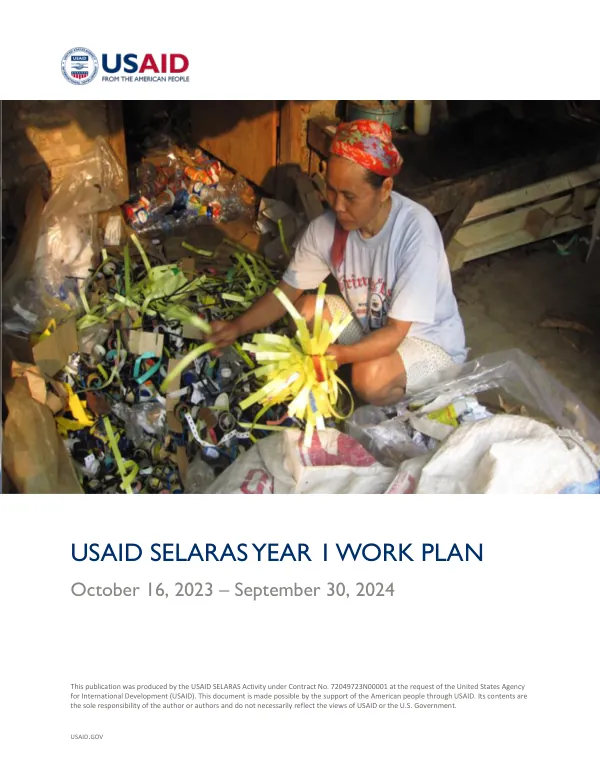
USAID SELARAS YEAR 1 ANNUAL WORK PLAN
The USAID SELARAS Activity is a program aimed at improving solid waste management in Indonesia.
2024 · 141 pages
Sign in to readA free account is required to download.
Abstract
The program is implemented by DAI Global LLC under Contract No. 72049723N00001, with funding from the United States Agency for International Development (USAID). The program's overall goal is to strengthen local markets and businesses for plastic waste, improve systems for tracking and reducing methane emissions from Indonesia's solid waste sector, and improve social behaviors and practices toward inclusive and sustainable solid waste management. The program's work plan for year one (October 16, 2023, to September 30, 2024) is organized around five objectives. Objective 1 focuses on strengthening solid waste sector governance and financing, with tasks such as analyzing local government budgets to support increased allocations for solid waste management and strengthening local government capacity in solid waste planning and budgeting. Objective 2 aims to improve and expand solid waste management services, with tasks such as assessing capacity and developing a capacity-building plan for solid waste management, establishing local solid waste management centers of excellence, and developing or updating solid waste master plans. Objective 3 focuses on strengthening local markets and businesses for plastic waste, with tasks such as assessing local waste management and 3R technologies and markets, launching an annual innovation challenge and women's entrepreneur award, and establishing an incubator for recycling and composting businesses. Objective 4 aims to improve social behaviors and practices toward inclusive and sustainable solid waste management, with tasks such as designing and implementing targeted public awareness campaigns, reinforcing messaging through direct engagement, and evaluating the effectiveness of social behavior change activities and sharing best practices. Objective 5 focuses on improving systems for tracking and reducing methane emissions from Indonesia's solid waste sector, with tasks such as developing a methodology for data collection to measure and model emissions, building stakeholder capacity to use the Solid Waste Emissions Estimation Tool (SWEET), and supporting decision making using the dashboard and SWEET. The program's cross-cutting activities include subcontracting, monitoring, evaluation, and learning, environmental compliance, gender equality and social inclusion, outreach and communications, stakeholder coordination, and private sector engagement. The program's budget for year one is outlined in Annex 2, and the anticipated international travel schedule is outlined in Annex 3.