DAI
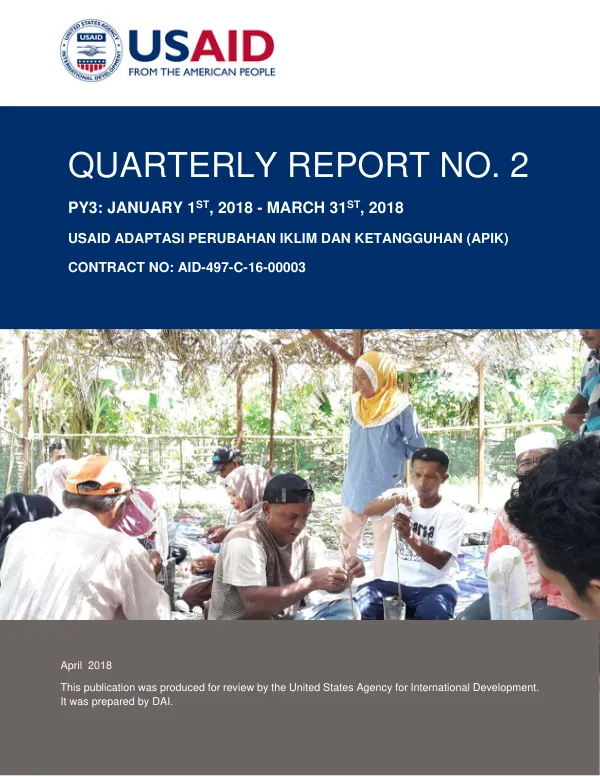
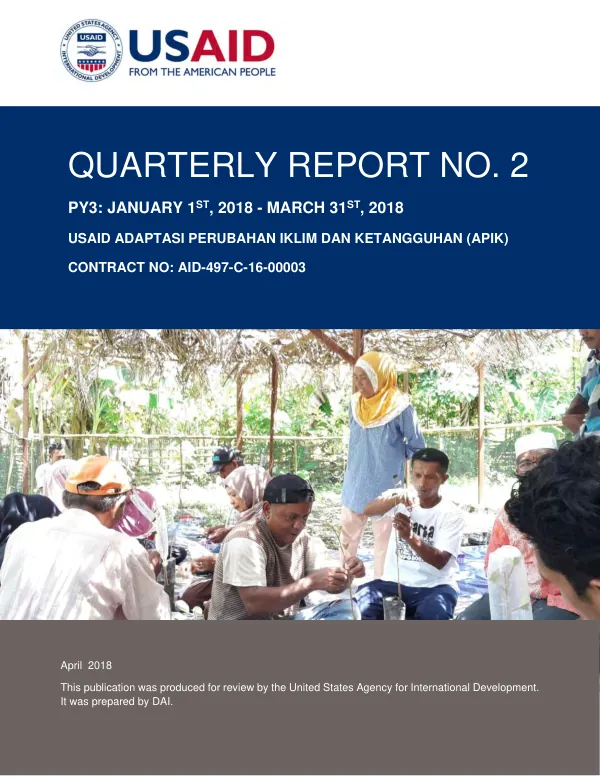
Quarterly Report 2 Year 3 – USAID Adaptasi Perubahan Iklim dan Ketangguhan (APIK)
The USAID Adaptasi Perubahan Iklim dan Ketangguhan (APIK) program is a collaborative effort between USAID, the Indonesian government, and local stakeholders to build resilience in communities vulnerable to climate change.
2018 · 62 pages
Sign in to readA free account is required to download.
Abstract
The program focuses on community-based adaptation actions, with a particular emphasis on supporting smallholder farmers and fishermen in Maluku and Papua regions. In the coastal village of Morella, Central Maluku, the APIK program has been working with the local community, led by the Hausihu Working Group (Pokja Hausihu), to address the impacts of climate change. The village is highly vulnerable to hydrometeorological disasters such as flooding, coastal erosion, and tidal surges, which have resulted in reduced crop yields and decreased livelihoods for the community. Through a participatory process, the community, with support from APIK, has developed an action plan to address the challenges. The plan includes building flood barrier infrastructure, improving drainage systems, providing solar dryers, a nursery, and an electronic display for real-time weather information. Some of these actions, such as flood prevention schemes and improved drainage, will be included in the local government development plan and budget. The collaboration between APIK, Pokja Hausihu, and PT Pertamina TBBM Wayame, a regional operational unit of PT Pertamina, has been instrumental in implementing the action plan. PT Pertamina has agreed to provide a grant to Pokja Hausihu for solar dryers, a nursery, and seedlings, and has committed to providing additional funding to support better access to weather information for the community. The partnership between APIK, Pokja Hausihu, and PT Pertamina TBBM Wayame is a crucial example of how partnerships, including with the private sector, can build local resilience. The project will serve as a case study to encourage other companies to engage with APIK in building local resilience. At the national level, APIK has made significant progress in Quarter 2 of Year 3. Highlights include the development of a national climate change adaptation strategy, the establishment of a national climate change adaptation fund, and the launch of a climate change awareness campaign. At the sub-national level, APIK has been working with regional governments and local stakeholders to implement climate change adaptation projects. In East Java, APIK has been working with the provincial government to develop a climate change adaptation plan, while in Southeast Sulawesi, APIK has been supporting the development of a climate-resilient agriculture project. Overall, the APIK program is making significant progress in building resilience in communities vulnerable to climate change. The program's focus on community-based adaptation actions, partnerships with local stakeholders, and support for smallholder farmers and fishermen is critical to addressing the impacts of climate change in Maluku and Papua regions.