POWER AFRICA
USAID Southern Africa Energy Program Lesotho Country Profile
The USAID Southern Africa Energy Program (SAEP) has been working in Lesotho to improve the country's power generation and access to electricity.
2024 · 2 pages
Sign in to readA free account is required to download.
Abstract
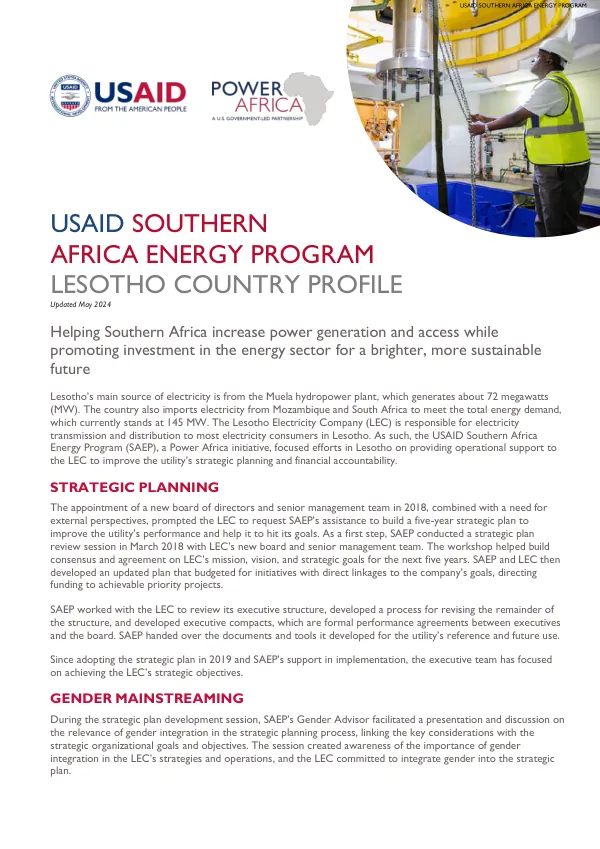
Lesotho's main source of electricity is the Muela hydropower plant, which generates approximately 72 megawatts (MW) of power. The country also imports electricity from Mozambique and South Africa to meet its total energy demand, which currently stands at 145 MW. The Lesotho Electricity Company (LEC) is responsible for electricity transmission and distribution to most electricity consumers in Lesotho. To improve the LEC's performance, SAEP provided operational support to the utility, focusing on strategic planning and financial accountability. In 2018, the LEC appointed a new board of directors and senior management team, prompting the utility to request SAEP's assistance in building a five-year strategic plan. SAEP conducted a strategic plan review session with the LEC's new board and senior management team, which helped build consensus and agreement on the utility's mission, vision, and strategic goals for the next five years. The updated plan budgeted for initiatives with direct linkages to the company's goals, directing funding to achievable priority projects. SAEP also worked with the LEC to review its executive structure, developed a process for revising the remainder of the structure, and developed executive compacts, which are formal performance agreements between executives and the board. Since adopting the strategic plan in 2019 and SAEP's support in implementation, the executive team has focused on achieving the LEC's strategic objectives. Additionally, SAEP facilitated a presentation and discussion on the relevance of gender integration in the strategic planning process, linking key considerations with the strategic organizational goals and objectives. The LEC committed to integrate gender into the strategic plan. The Lesotho Electricity and Water Authority (LEWA) requested the LEC to ringfence its core business units for regulatory purposes. SAEP acted as the utility's independent advisor in this process, and the key aspects of the ringfencing process were accepted by the LEC executive committee in January 2020. The conclusion of the ringfencing exercise will result in individual accounts and income statements for each functional area (generation, transmission, and distribution), which will help the utility to analyze and manage each functional area separately. This will also improve the likelihood that LEC's future tariff increase requests to LEWA will be approved, increasing its income and thus enabling increased infrastructure investment and improved service. Lesotho has abundant renewable energy resources such as solar, wind, and hydropower. Realizing the potential of these resources is a focus of the Lesotho Energy Policy 2015-2025. Utility instability and general energy sector uncertainty, particularly related to mini-grid regulations, have been a continuing barrier to support. SAEP has provided limited assistance to Power Africa Partner One Power's Neo 1 solar PV project and three additional renewable energy projects. In 2023, SAEP provided input to One Power's corporate and project-level fundraising by reviewing One Power's fundraising deck and providing guidance on other factors that could influence fundraising efforts.
Related documents