USAID DEC
USAID Southern Africa Energy Program (SAEP) Mitigating Wildlife and Energy Infrastructure Collisions in Mozambique
Sign inUSAID
USAID Southern Africa Energy Program (SAEP) Mitigating Wildlife and Energy Infrastructure Collisions in Mozambique
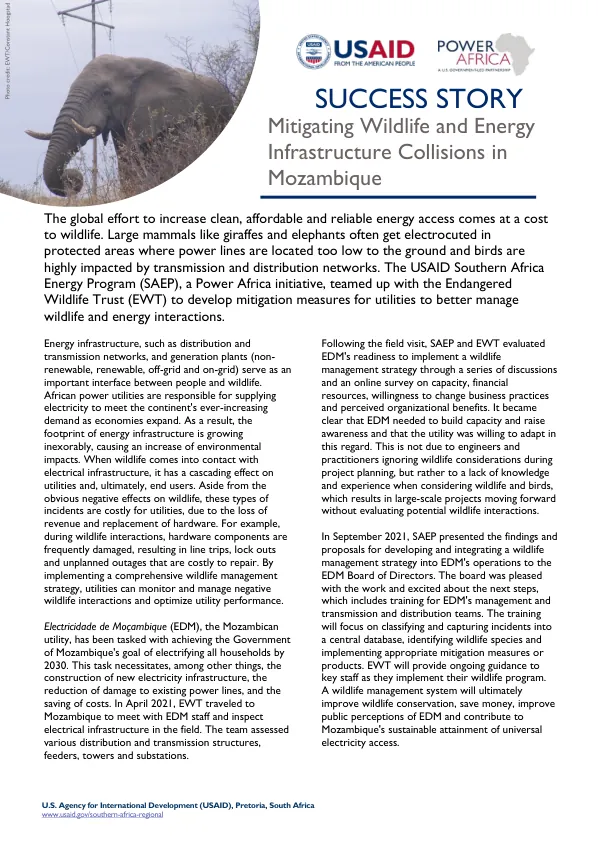
The USAID Southern Africa Energy Program (SAEP), a Power Africa initiative, collaborated with the Endangered Wildlife Trust (EWT) to develop mitigation measures for utilities to better manage wildlife and energy interactions.
2021 · 1 pages
Sign in to readA free account is required to download.
Abstract
Energy infrastructure, such as distribution and transmission networks, and generation plants, serves as an important interface between people and wildlife. African power utilities are responsible for supplying electricity to meet the continent's ever-increasing demand as economies expand, resulting in a growing footprint of energy infrastructure and increased environmental impacts. When wildlife comes into contact with electrical infrastructure, it has a cascading effect on utilities and end users. Negative effects on wildlife include electrocution and habitat disruption, while utilities incur costs due to hardware damage, line trips, lockouts, and unplanned outages. For example, hardware components are frequently damaged during wildlife interactions, resulting in costly repairs. By implementing a comprehensive wildlife management strategy, utilities can monitor and manage negative wildlife interactions and optimize utility performance. Electricidade de Moçambique (EDM), the Mozambican utility, has been tasked with achieving the Government of Mozambique's goal of electrifying all households by 2030. This task necessitates the construction of new electricity infrastructure, reduction of damage to existing power lines, and cost savings. In April 2021, EWT traveled to Mozambique to meet with EDM staff and inspect electrical infrastructure in the field. The team assessed various distribution and transmission structures, feeders, towers, and substations. Following the field visit, SAEP and EWT evaluated EDM's readiness to implement a wildlife management strategy through discussions and an online survey on capacity, financial resources, willingness to change business practices, and perceived organizational benefits. The evaluation revealed that EDM needed to build capacity and raise awareness, but the utility was willing to adapt. This is not due to a lack of consideration for wildlife during project planning, but rather a lack of knowledge and experience when considering wildlife and birds, resulting in large-scale projects moving forward without evaluating potential wildlife interactions. In September 2021, SAEP presented the findings and proposals for developing and integrating a wildlife management strategy into EDM's operations to the EDM Board of Directors. The board was pleased with the work and excited about the next steps, which include training for EDM's management and transmission and distribution teams. The training will focus on classifying and capturing incidents into a central database, identifying wildlife species, and implementing appropriate mitigation measures or products. EWT will provide ongoing guidance to key staff as they implement their wildlife program. A wildlife management system will ultimately improve wildlife conservation, save money, improve public perceptions of EDM, and contribute to Mozambique's sustainable attainment of universal electricity access.
Related documents