USAID DEC
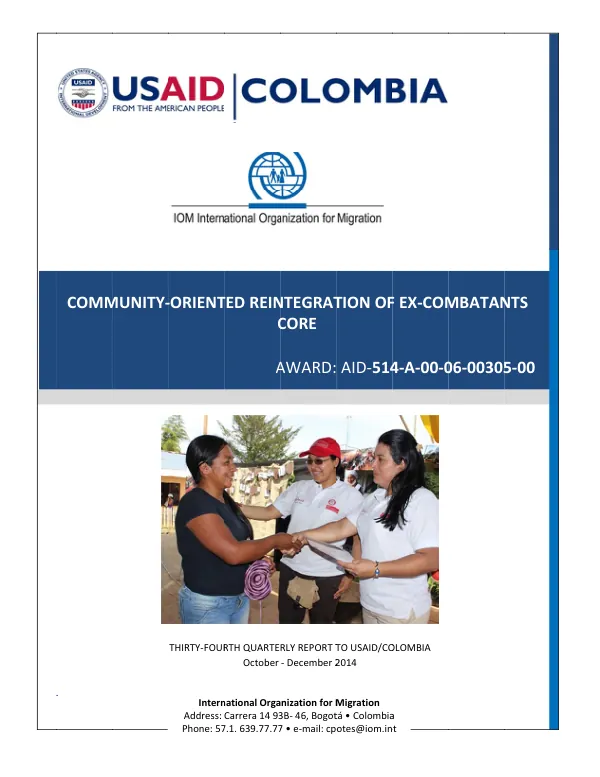
USAID supports the International Organization for Migration (IOM) in Colombia through the Recruitment Prevention and Reintegration (RPR) Program
Sign inINTERNATIONAL COMMITTEE FOR THE RED CROSS
USAID supports the International Organization for Migration (IOM) in Colombia through the Recruitment Prevention and Reintegration (RPR) Program
The Colombian government, with support from the International Organization for Migration (IOM), is implementing the Recruitment Prevention and Reintegration (RPR) Program to provide institutional strengthening for the Government of Colombia (GOC) in supporting legal, social, and economic reintegration services to demobilized adults and disengaged children, as well as to prevent new recruitment.
2016 · 4 pages
Sign in to readA free account is required to download.
Abstract
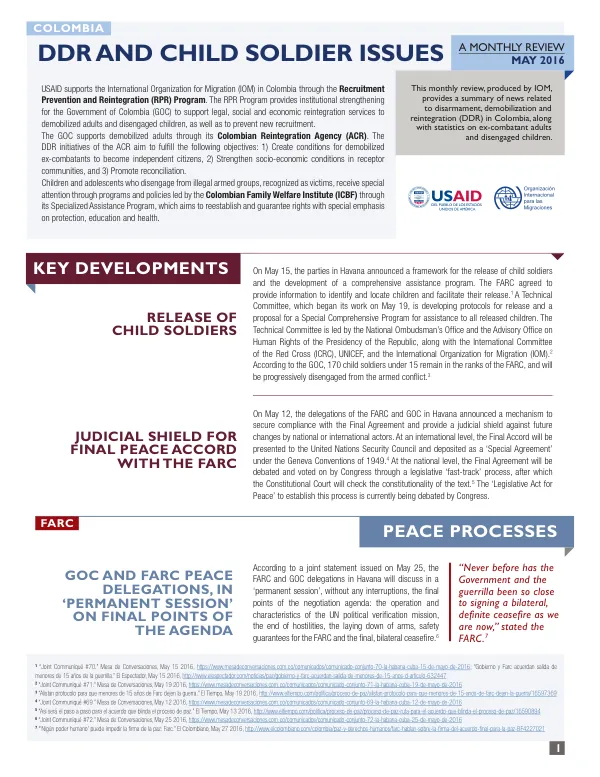
The GOC's Colombian Reintegration Agency (ACR) supports demobilized adults through DDR initiatives that aim to create conditions for demobilized ex-combatants to become independent citizens, strengthen socio-economic conditions in receptor communities, and promote reconciliation. Demobilized adults receive support through the ACR, while children and adolescents who disengage from illegal armed groups, recognized as victims, receive special attention through programs and policies led by the Colombian Family Welfare Institute (ICBF) through its Specialized Assistance Program. This program aims to reestablish and guarantee rights with special emphasis on protection, education, and health. On May 15, the parties in Havana announced a framework for the release of child soldiers and the development of a comprehensive assistance program. The FARC agreed to provide information to identify and locate children and facilitate their release. A Technical Committee, led by the National Ombudsman's Office and the Advisory Office on Human Rights of the Presidency of the Republic, along with the International Committee of the Red Cross (ICRC), UNICEF, and the International Organization for Migration (IOM), is developing protocols for release and a proposal for a Special Comprehensive Program for assistance to all released children. According to the GOC, 170 child soldiers under 15 remain in the ranks of the FARC, and will be progressively disengaged from the armed conflict. The FARC and GOC delegations in Havana announced a mechanism to secure compliance with the Final Agreement and provide a judicial shield against future changes by national or international actors. The FARC and GOC delegations in Havana will discuss in a 'permanent session', without any interruptions, the final points of the negotiation agenda, including the operation and characteristics of the UN political verification mission, the end of hostilities, the laying down of arms, safety guarantees for the FARC, and the final, bilateral ceasefire. The FARC stated that "never before has the Government and the guerrilla been so close to signing a bilateral, definite ceasefire as we are now." Hostilities recently took place between the FARC and the Colombian Armed Forces in the eastern department of Meta, with the FARC's Eastern Bloc announcing that they will no longer 'study' the peace accords, implying a lack of control by the FARC leadership and potential opposition to the peace process among some FARC units. The GOC stated that the FARC have violated the unilateral ceasefire three times since its official declaration in July 2015. The Colombian Army released posters of guerrilla members accused of killing two soldiers and wounding two others in the region of Caquetá. A top FARC leader contested the accusation, stating that the group has respected its unilateral ceasefire and that recent military operations may delay a final, bilateral ceasefire. The ELN, the second largest guerrilla in Colombia, proposed a bilateral ceasefire with the GOC, and insisted on the development of 'mutual humanitarian actions' regarding the negotiation process. The ELN also "regretted" the five-day kidnapping of three journalists in the department of Norte de Santander.
Related documents