TETRA TECH ARD, INC.
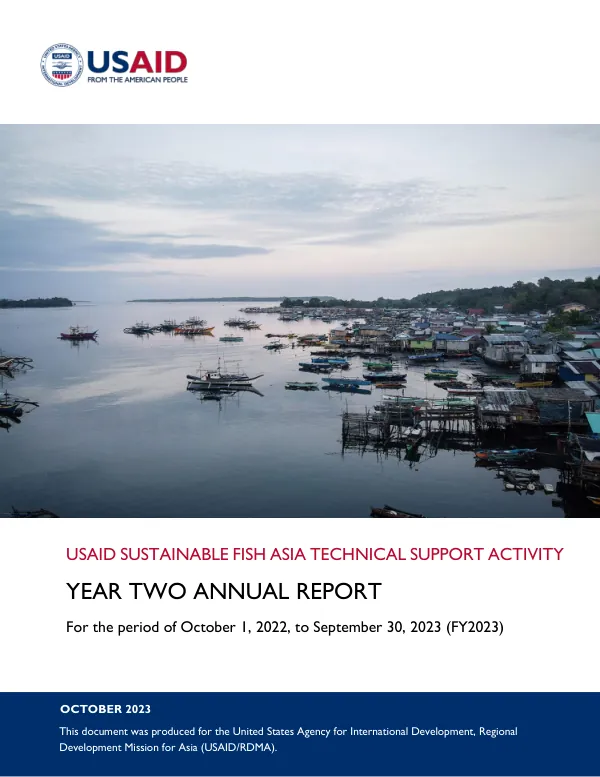
USAID Sustainable Fish Asia Technical Support Activity: Year Two Annual Report
The USAID Sustainable Fish Asia Technical Support Activity is a regional initiative aimed at promoting sustainable fisheries management in Southeast Asia.
2023 · 69 pages
Sign in to readA free account is required to download.
Abstract
The activity is implemented by Tetra Tech ARD and is funded by the United States Agency for International Development (USAID) Regional Development Mission for Asia (USAID/RDMA). The initiative focuses on five strategic objectives: adoption and implementation of regional sustainable fisheries policies, standards, and regulatory frameworks; increase in the adoption of fair labor and sustainable fishing practices by fishery businesses in the region; effective and efficient project coordination, administrative and technical support, and outreach and communications delivered; improved social inclusion within regional fisheries management, including small-scale fishermen, women, and youth empowerment; and institutions and countries empowered to safeguard their fishery resources from foreign malign influences. The activity has made significant progress in achieving its strategic objectives. In the area of regional sustainable fisheries policies, standards, and regulatory frameworks, the initiative has established regional multi-stakeholder platforms and improved fisheries governance frameworks. This has led to improved information to strengthen regional fisheries management and enforcement. The initiative has also facilitated the integration of gender equality and social inclusion (GESI) into regional fisheries management. In terms of fair labor and sustainable fishing practices, the activity has partnered with the private sector to adopt fair labor standards and improve market access for responsible fishing practices. The initiative has also strengthened regional industry forums and promoted the adoption of fisheries traceability technologies. The activity has also provided technical support to regional partner organizations and strengthened their ability to convene, coordinate, and influence. The initiative has also made significant progress in promoting social inclusion within regional fisheries management. This includes the establishment of a youth advisory platform (YAP) and the empowerment of women to lead change in sustainable fisheries management. The activity has also partnered with the Southeast Asia Fish for Justice (SEAFISH) network to expand the role of women and marginalized groups in regional seafood markets. In terms of safeguarding fishery resources from foreign malign influences, the initiative has provided a safe space for marginalized groups to voice their concerns and has engaged with relevant government agencies on maritime and labor enforcement. The activity has also collaborated with regional organizations to enhance maritime domain awareness (MDA). The activity has also made significant progress in sustainability, communications and outreach, administration and operations, and monitoring, evaluation, and learning. The initiative has assessed the effectiveness of its monitoring, evaluation, and learning (MEL) plan and has made significant progress against annual targets for indicators included in the MEL plan. The activity has also identified unanticipated challenges in the collection of evaluation data and has proposed revisions to the MEL plan. The initiative has also faced several challenges and lessons learned during the reporting period. These include the need for more effective coordination and collaboration with regional organizations and the need for more robust data collection and analysis. The activity has also identified opportunities for improvement in the next reporting period, including the establishment of regional multi-stakeholder platforms and the promotion of fair labor and sustainable fishing practices. Overall, the USAID Sustainable Fish Asia Technical Support Activity has made significant progress in promoting sustainable fisheries management in Southeast Asia. The initiative has achieved its strategic objectives and has made significant progress in promoting social inclusion, safeguarding fishery resources, and improving sustainability.
Related documents