USAID
USAID/Tanzania Public Sector Systems Strengthening Plus Success Story April 2021
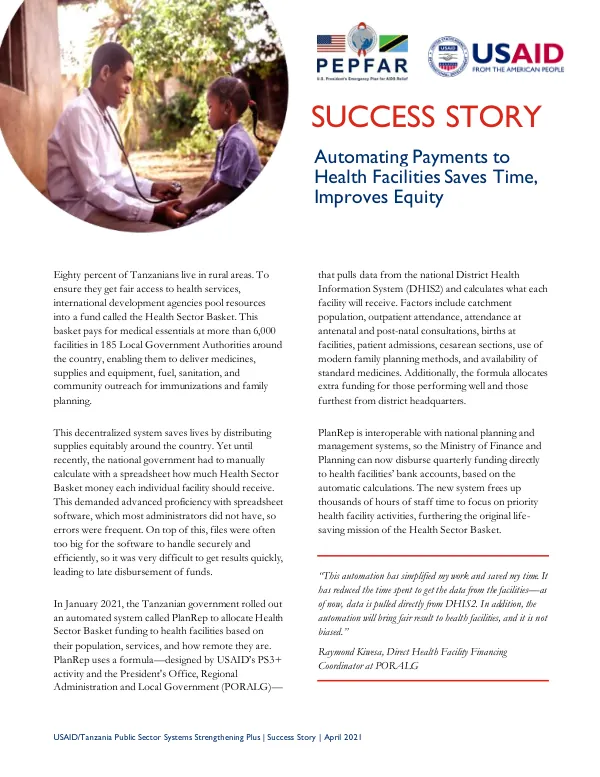
The Tanzanian government, in collaboration with the USAID/PS3+ activity, implemented an automated system to calculate Health Sector Basket allocations for each facility in the Planning and Reporting (PlanRep) System in January 2021.
2021 · 1 pages
Sign in to readA free account is required to download.
Abstract
The automated system pulls data from the national District Health Information System (DHIS2) and calculates what each facility will receive. Data include catchment population, distance from council headquarters, outpatient attendance, attendance at antenatal and post-natal consultations, births at facilities, patient admissions, cesarean sections, use of modern family planning methods, and availability of standard medicines. Prior to the automation, the national government had to manually calculate allocations using a spreadsheet, which demanded advanced proficiency with spreadsheet software and often resulted in errors. Files were frequently too large for the software to handle securely and efficiently, leading to late and unequal disbursement of funds. The automated system has eliminated these challenges, enabling the Ministry of Finance and Planning to disburse quarterly funding directly to health facilities' bank accounts based on the automatic calculations. The PlanRep system is interoperable with national planning and management systems, allowing for seamless data exchange and efficient processing. The automation has also freed up thousands of hours of staff time, enabling them to focus on priority health facility activities. This has furthered the original life-saving mission of the Health Sector Basket, which pools resources into a fund to ensure fair access to health services for Tanzanians living in rural areas. The Health Sector Basket is a critical component of the Tanzanian healthcare system, providing medical essentials directly to over 6,000 facilities across 185 Local Government Authorities. Allocations to each individual service provider are determined by catchment population, service utilization, remoteness, and performance. The automated system has ensured that these allocations are calculated accurately and efficiently, facilitating the availability of supplies equitably around the country. The success of the automated system has been acknowledged by Raymond Kiwesa, Direct Health Facility Financing Coordinator at PO-RALG, who stated that the automation has simplified his work, saved time, and reduced bias in the allocation process. The system has also improved the overall efficiency of the Health Sector Basket, enabling the timely disbursement of funds and furthering the mission of ensuring fair access to health services for all Tanzanians.
Related documents