JOHNS HOPKINS UNIVERSITY
Success Story: Routine Immunization in Kibuku District, Uganda
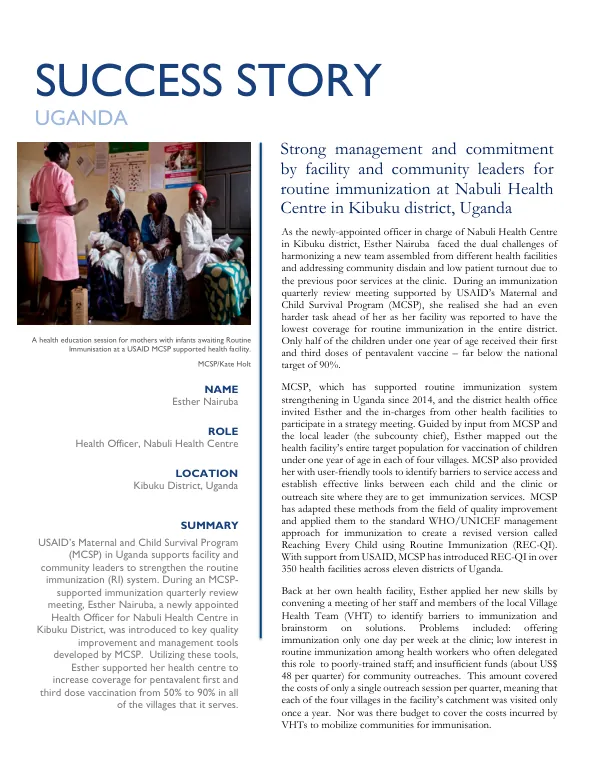
Strong commitment and leadership by Esther Nairuba, the Health Officer at Nabuli Health Centre in Kibuku district, Uganda, have led to significant improvements in routine immunization coverage.
2021 · 2 pages
Sign in to readA free account is required to download.
Abstract
Esther's efforts have resulted in a substantial increase in the number of children receiving the first and third doses of pentavalent vaccine. Prior to her involvement, the health centre had the lowest coverage for routine immunization in the entire district, with only half of the children under one year of age receiving the vaccine. Esther's approach involved introducing key quality improvement and management tools developed by the USAID Maternal and Child Survival Program (MCSP). These tools, adapted from the field of quality improvement, were applied to the standard World Health Organization/United Nations Children's Fund (WHO/UNICEF) approach for immunization to create a revised version called Reaching Every Child using Routine Immunization (REC-QI). Esther used these tools to map out the health centre's target population for vaccination and identify barriers to service access. With support from MCSP and the district health office, Esther convened a meeting with her staff and local Village Health Team (VHT) members to brainstorm solutions to the identified problems. The identified problems included offering immunization only one day per week at the clinic, low interest in routine immunization among health workers, and insufficient funds for community outreaches. Esther and her team introduced changes to address these issues, including offering immunization twice per week, assigning qualified staff to vaccinate children and women, and doubling the allocated funds for immunization. Esther also recognized the need to engage the local community in the immunization process. She and her team provided family planning products of choice to mothers while they waited for their children to be vaccinated, which increased their interest in attending the outreaches. Additionally, they ensured that community mobilizers met with local leaders to promote the use of services and address anti-vaccination rumors. The efforts of Esther and her team have resulted in a significant increase in routine immunization coverage. Within six months, the health centre reported a 90% coverage for the first and third doses of pentavalent vaccine in all the villages it serves. Esther attributes these improvements to her leadership, community engagement, and use of data to determine the most effective strategies for improving services. Her approach has been successful in addressing the challenges faced by the health centre, including limited resources, and has provided a model for other health facilities to follow.