CDM SMITH INTERNATIONAL INC.
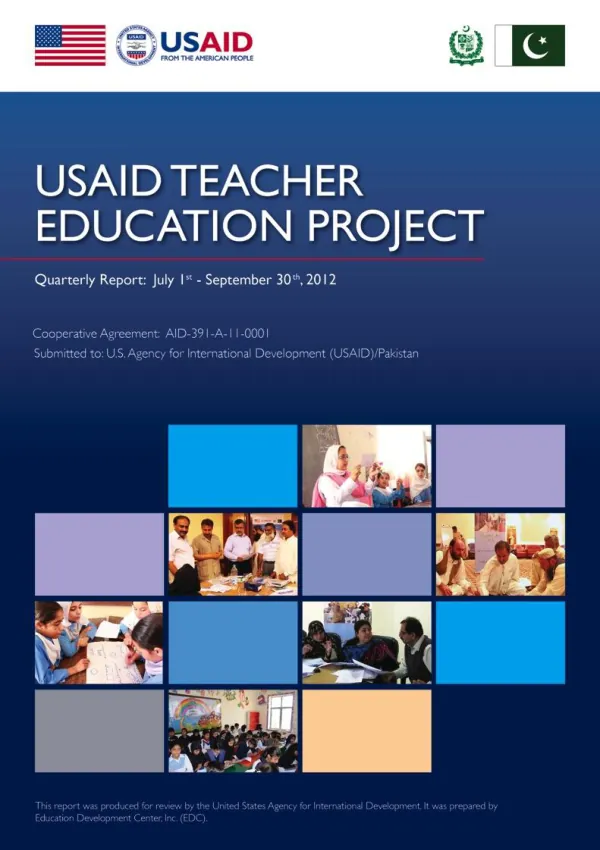
USAID Teacher Education Project – Quarterly Progress Report (July-Sept, 12)
The USAID Teacher Education Project in Pakistan continued its efforts to implement activities related to the expansion and delivery of the two-year associate degree in education (ADE) and four-year bachelor of education honours [B.Ed.
2012 · 89 pages
Sign in to readA free account is required to download.
Abstract
(Hons.)] programs. In accordance with the approved re-programming from USAID, the Project hired 40 additional staff to assist with the expedited implementation of project activities. During the reporting period, 49 trainings were organized with a total of 1,424 participants, 515 females and 909 males. The Project provided technical support to the provincial and regional departments of education for developing their respective Teacher Education Strategies (TES) 2018. The Department of Education for Gilgit Baltistan (GB) issued an official notification this quarter for establishing an apex institution for teacher education in the province. The Department of Education for AJK developed a proposal for establishing a Quality Assurance Cell (QAC) at the Directorate of Curriculum and Research Development (DCRD). The Government of Balochistan held its first implementation meeting of the TES 2018 during the quarter. The Project also organized eight strategic planning workshops this quarter, which were attended by 80 task force members from four universities. The strategic plans of universities are currently being copyedited for publication and dissemination with stakeholders. To effectively implement the recently introduced ADE and B.Ed. (Hons.) degree programs in selected universities, USAID, in partnership with CDM Smith and the USAID Teacher Education Project is constructing Faculty of Education buildings at six partner universities and renovating one existing partner university building. During the current quarter, the USAID Teacher Education Project continued to liaise with USAID and CDM Smith in regards to the infrastructure projects (six new construction projects and one renovation) with partner universities. The design concepts were presented to two universities, while the 611 (e) for Hazara University was approved this quarter by USAID. The Project facilitated the development of 47 College Improvement Plans across Pakistan. These plans were reviewed by the provincial apex institutions and approved by senior officials from the provincial education departments. Furthermore, the project recruited a national consultant to facilitate provincial PC-1 planning meetings and workshops. These meetings were also attended by officials from apex institutions and provincial Planning and Development (P&D) departments. These officials will continue to support colleges with the development of PC-1's once the project completes its tenure, thus ensuring sustainability of initiatives. The USAID Teacher Education Project continued its efforts to work with the provincial governments for the revision of recruitment rules. The revised recruitment rules for Khyber Pakhtunkhwa were developed, approved by the education department and have been sent to the Service Structure Review Committee. The Government of Azad Jammu and Kashmir (AJK) issued an official notification this quarter with updates on service rules. The Government of Gilgit-Baltistan (GB) issued an official notification in September 2012 on the recruitment eligibility criteria for ADE and B.Ed. (Hons.) graduates. The project in partnership with the Agha Khan University Institute for Education Development (AKU-IED) launched a summer institute on education leadership and management for college principals in Karachi. A total of 27 principals and faculty members from government colleges from across the country participated in the summer institute. During this quarter, work continued on course development, with the aim of producing high-quality educational materials for teacher education programs. The USAID Teacher Education Project is working closely with the Higher Education Commission (HEC) and the Ministry of Education (MoE) to develop and implement a comprehensive teacher education strategy for Pakistan. The project is also providing technical assistance to the provincial governments to develop and implement their respective teacher education strategies. The project's efforts are focused on improving the quality of teacher education in Pakistan, with a particular emphasis on the development of the ADE and B.Ed. (Hons.) programs. The project is also working to strengthen the capacity of the provincial governments to manage and implement teacher education programs. The project's activities are being closely monitored and evaluated to ensure that they are meeting their intended objectives. The project's progress is being reported to USAID and other stakeholders on a regular basis.