CENTER FOR EDUCATIONAL DEVELOPMENT
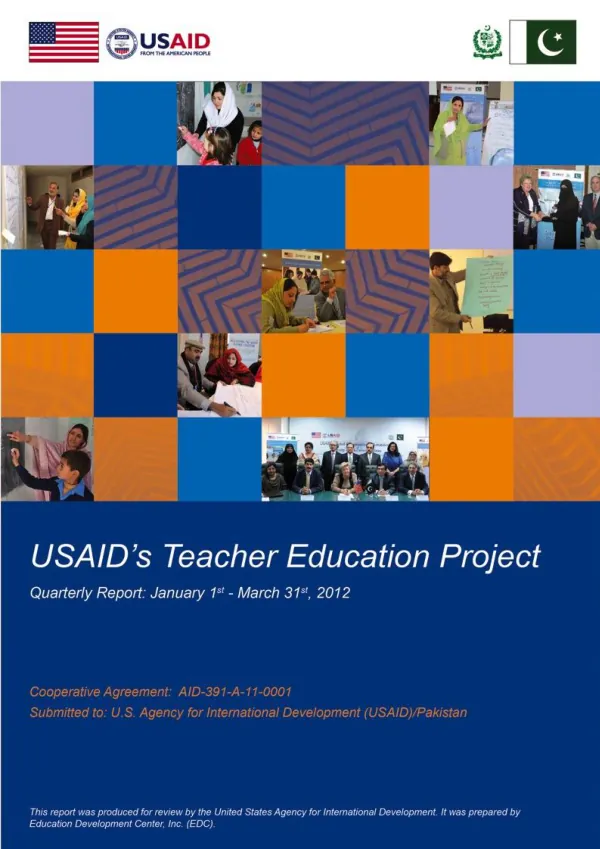
USAID's Teacher Education Project – Quarterly Progress Report
USAID's Teacher Education Project in Pakistan began its activities in 2012 with the goal of improving teacher education systems and policies.
2012 · 95 pages
Sign in to readA free account is required to download.
Abstract
The project focused on three main objectives: improving systems and policies that support teachers, teacher educators, and educational managers; supporting the Higher Education Commission and Ministry of Education to develop and revise standards, curricula, and modules for pre-service teacher education degrees; and developing a plan for implementing new curricula for new and existing teachers. During the reporting period of January through March 2012, the project undertook several important initiatives. The Second National Consultative Interchange was held in Islamabad, which provided an opportunity for stakeholders to provide feedback on the project's work plan and agree upon the work plan for the remaining year. The project also worked closely with the Higher Education Commission, provincial education departments, and partner colleges and universities to implement activities related to the expansion and delivery of the two-year associate degree in education (ADE) and four-year bachelor of education honours (B.Ed. Hons.) programs. Provincial strategic planning was a key focus area during this quarter. Staff from the project and Teachers College, Columbia University worked closely with provincial teacher education task forces to assist them with further development of their strategic plans on teacher education. Seven meetings were organized on the draft Teacher Education Strategy 2018 (TES 2018), which were attended by task force members from all regions of the country. University strategic planning was also a major activity during this quarter. The project organized eight strategic planning workshops, which were attended by 101 task force members from 10 universities. Through technical assistance from the project, five Cohort I institutes completed their strategic plans, while three universities out of six from Cohort II identified their respective task forces and began work on a situational analysis of their strategic plans. Technical assistance for infrastructure projects was another key area of focus. USAID, in partnership with CDM Smith and USAID's Teacher Education Project, is constructing Faculty of Education buildings at six partner universities and renovating one existing building. A ceremony was held during this quarter to mark the signing of the project's memoranda of understanding (MoU) at the Higher Education Commission (HEC). The building design for the Faculty of Education Hazara University (HU) was also completed after input from USAID's Teacher Education Project curriculum experts and consultations with university faculty members. College improvement planning (CIP) was initiated in all provinces and regions during this quarter. Representatives from apex institutions, principals, and senior faculty members of Cohort I and II colleges attended a series of one-day orientation workshops at the regional headquarters. The project also hired Provincial Strategic Planning Coordinators for Sindh, Khyber Pakhtunkhwa (KPK), and Punjab to assist colleges in developing and implementing their CIPs. Revision of recruitment rules for elementary teachers was another significant achievement during this quarter. Through efforts of USAID's Teacher Education Project, the Department of Education (KPK) incorporated the ADE as a qualification for the recruitment of elementary school teachers. The service rules for Gilgit Baltistan were also finalized and approved for the elementary school teachers, and ADE graduates are designated as grade 14 on the pay scale. Course development was another key area of focus during this quarter. USAID's Teacher Education Project, in collaboration with curriculum advisors from Teachers College, Columbia University, organized seven course design workshops to prepare drafts of syllabi and course guides for ADE and B.Ed. (Hons.) degree programs. Ninety-seven participants attended these workshops, and as a result, faculty members from the project's partner colleges and universities were able to develop course syllabi, personalized teaching materials, and other educational resources.