GOVERNMENT OF ETHIOPIA
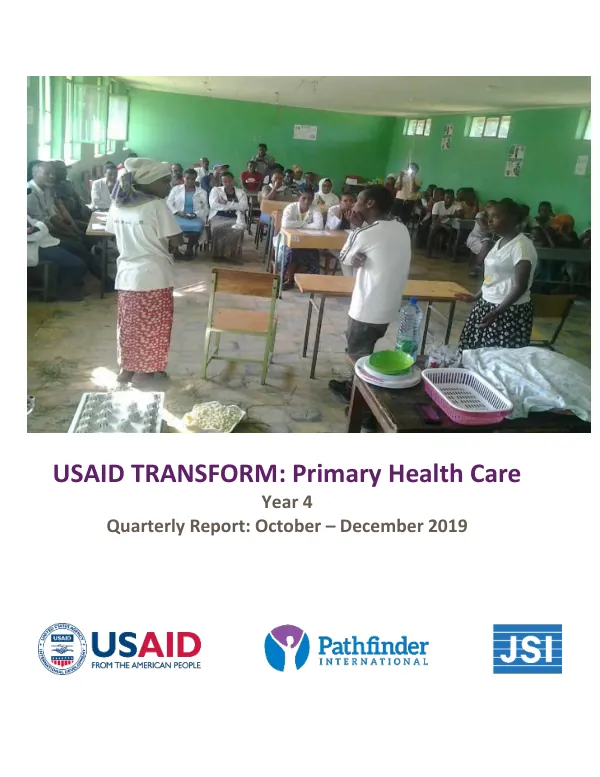
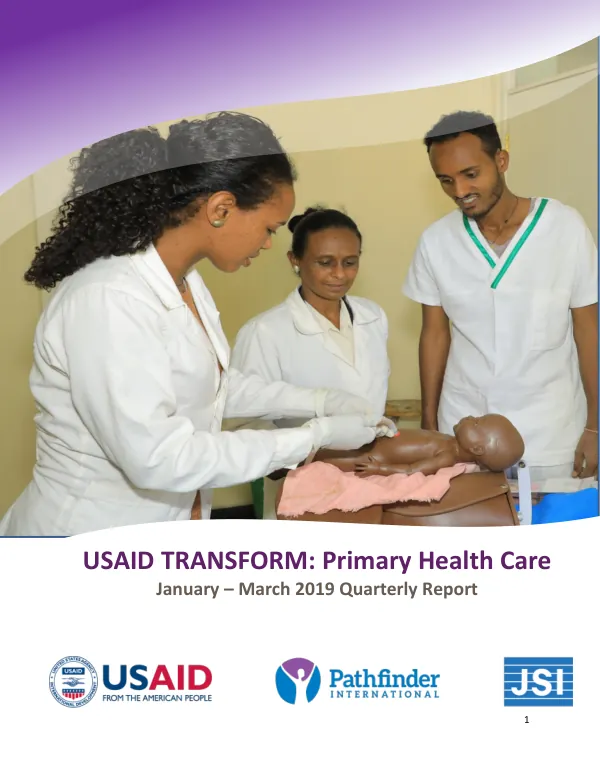
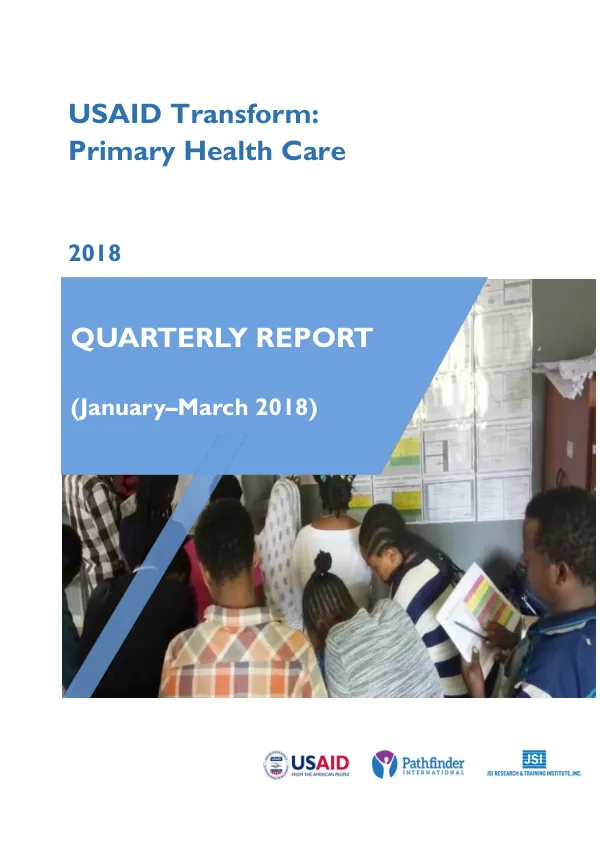
USAID Transform: Primary Health Care, Quarter Report, January – March, 2018
The USAID Transform: Primary Health Care Project is categorized into four result areas: improving performance management and improvement, quality of care, demand for service, and collaborative learning and adaptation.
2018 · 53 pages
Sign in to readA free account is required to download.
Abstract
The project's major achievements during the reporting quarter are highlighted below. Health systems management and performance have been improved through the introduction of performance management standards to nearly all project target woredas and health facilities. Six percent of health centers reported greater than 85% of key performance indicators. A total of 243 performance improvement grant agreements were signed with government entities, and 141 Leadership, Management, and Governance (LMG) projects were developed. Additionally, 25 Primary Health Care Units (PHCUs) have started implementing integrated PHCU level performance review meetings and capacity enhancement initiatives. Furthermore, 29 institutions were supported on gender analysis and planning, and various supports were extended to improve the implementation of Community-Based Health Insurance (CBHI) in old and new sites. Preparation to improve public finance management was also finalized. Quality of care has been improved through various interventions. A total of 57 facilities were enabled to provide on-site Family Planning (FP) trainings, and 52% of facilities provide a complete method mix. Additionally, 51% of facilities have Basic Emergency Obstetrics and Newborn Care (BEmONC) signal functions at the day of visits. Furthermore, 76 primary hospitals were supported to establish Newborn Intensive Care Unit (NICU) teams, and 25 facilities were capacitated to provide on-site Integrated Management of Neonatal and Childhood Illnesses (IMNCI) trainings. Moreover, 54 new Youth-Friendly Service (YFS) sites were supported, and 95 facilities were supported to be youth responsive. Additionally, 3,825 Health Centers/Health Posts (HC/HP) and 402 Health Centers (HCs) reported functional Outpatient Therapeutic Program (OTP) and Safe Child Birth Checklist (SCBC), respectively. In addition, 121 Obstetric Fistula (OF) cases were referred for treatment, and 21 new woredas enrolled in Maternal and Newborn Health (MNH) Quality Improvement Collaborative. Furthermore, 11 operations researches to fill knowledge gaps were identified and developed by selected staff of government entities within the three regional states. Progress in service uptake in project-supported areas has been measured using Health Management Information System (HMIS) data. Although Jan-Mar 2018 HMIS data is not fully collected due to the introduction of the revised HMIS using District Health Information System Version 2 (DHIS2) instance, quarterly trend analysis will help in showing progress towards objectives and indicating client load by quarter for planning. Below is the quarterly progress in service uptake for some selected indicators for the period Apr-Dec 2017. Overall, there is an improvement in service uptake for Family Planning, Maternal, and Child Health service uptake. However, service uptake dropped in July to Sept 2017 in some indicators, which might be due to the reason that July to September is the very busy agricultural season and rainy season. In addition, adolescents may be away from towns as schools closed in this period. Trends in Contraceptive Acceptance Rates (CAR) in project areas show an increase from 62.3% in April-June 2017 to 64.6% in Oct-Dec 2017 for women aged 15-49. Similarly, CAR for women aged 15-24 increased from 62.9% in April-June 2017 to 75.0% in Oct-Dec 2017. Trends in Maternal and Newborn Health (MNH) service uptake in project areas show an increase from 58.7% in April-June 2017 to 64.5% in Oct-Dec 2017 for ANC4+ services. Additionally, the percentage of women receiving Skilled Delivery (SD) services increased from 82.6% in April-June 2017 to 89.3% in Oct-Dec 2017. Trends in vaccination uptakes show an increase from 80.3% in April-June 2017 to 93.7% in Oct-Dec 2017 for Pentavalent 3 (Pen3) vaccinations.