USAID DEC
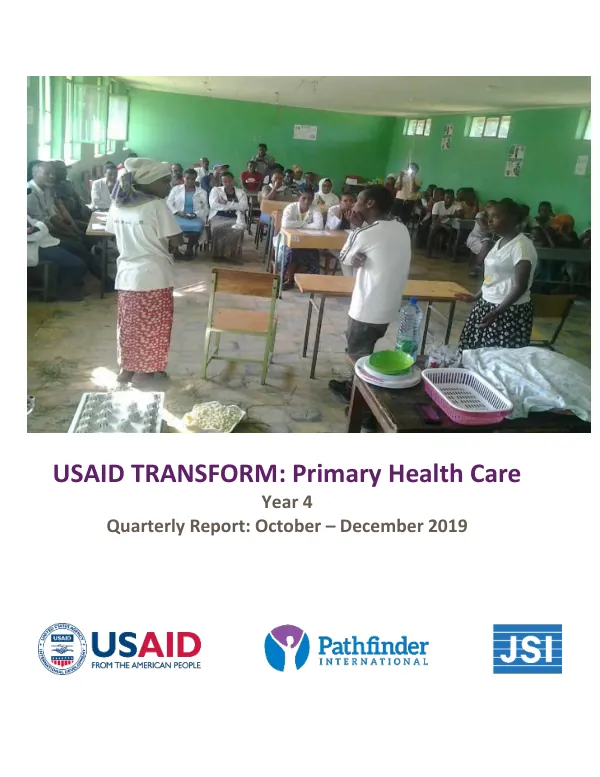
USAID TRANSFORM: Primary Health Care Year 4 Quarterly Report: October – December 2019
Sign inFEDERAL MINISTRY OF HEALTH
USAID TRANSFORM: Primary Health Care Year 4 Quarterly Report: October – December 2019
The primary health care initiative in Ethiopia, USAID TRANSFORM, aimed to improve the quality and accessibility of health services at the primary level.
2019 · 71 pages
Sign in to readA free account is required to download.
Abstract
The program focused on four key results: improved management and performance of the health system, increased sustainable quality of service delivery, improved household and community health practices, and enhanced program learning to impact policy and programming. Improved management and performance of the health system was achieved through the establishment and strengthening of innovative processes to enhance health system management and performance. This included the development of a connected woreda strategy, which aimed to improve the functionality of the health system within the context of primary-level care. The program also strengthened leadership, governance, and management at the woreda and primary health care unit levels. The program made significant progress in increasing sustainable quality of service delivery across the primary health care continuum of care. This included strengthening skills for the delivery of quality and integrated reproductive, maternal, newborn, child, and adolescent health and nutrition services. The program also improved provider behaviors and communication skills, as well as the management of health service delivery and oversight of service quality. In terms of household and community health practices, the program increased individual and household-level care-seeking behavior and uptake of healthy practices. The program also strengthened the enabling environment for health-seeking behavior, including community engagement in health service oversight. Additionally, the program enhanced the capacity of the health system to generate learning and evidence, which informed programming and policy related to preventing child and maternal deaths. The program's achievements were reflected in various indicators, including a 27% increase in household income among program participants compared to the control group. The program's success was also evident in the increased immunization coverage of children in Tigray, with a 20% increase in the percentage of children vaccinated between 2017 and 2019. The program's partnership and collaboration with local and global stakeholders were critical to its success. The program worked closely with the Federal Ministry of Health, the Ethiopian Health Insurance Agency, and other key stakeholders to ensure that the program's activities were aligned with national priorities and policies. The program also provided technical assistance and support to health facilities and woredas to improve their capacity to deliver high-quality health services. In terms of data management and monitoring, the program used a variety of tools and indicators to track progress and identify areas for improvement. The program's quarterly monitoring and evaluation plan included a range of indicators, including health facility performance, provider behavior, and community health practices. The program also used data from the District Health Information System 2 to track progress and identify areas for improvement. Overall, the USAID TRANSFORM primary health care initiative made significant progress in improving the quality and accessibility of health services in Ethiopia. The program's achievements reflect the importance of investing in primary health care and the need for continued support to strengthen the health system and improve health outcomes.
Related documents