AFRICAN WILDLIFE FOUNDATION
USAID Tuhifadhi Maliasili Activity Monthly Report January 2023
The USAID Tuhifadhi Maliasili Activity is a program aimed at promoting biodiversity conservation and natural resources management in Tanzania.
2023 · 9 pages
Sign in to readA free account is required to download.
Abstract
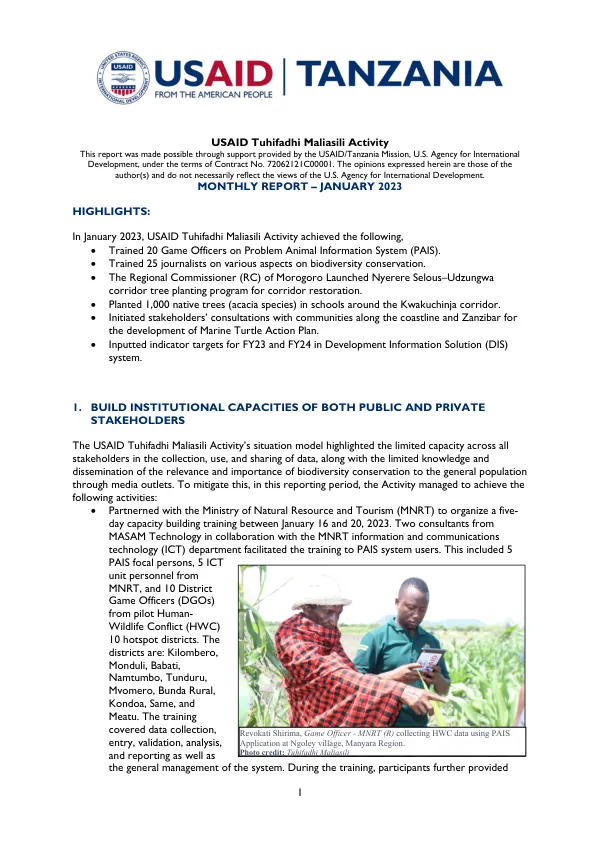
The program focuses on building institutional capacities of both public and private stakeholders, increasing private sector engagement in biodiversity conservation, and promoting sustainable livelihoods in areas of connectivity. Capacity building training was conducted for 20 Game Officers on the Problem Animal Information System (PAIS) in January 2023. The training covered data collection, entry, validation, analysis, and reporting, as well as the general management of the system. Participants also provided comments and inputs that helped improve the system prior to wider application. Additionally, a five-day capacity building training was organized for 15 PAIS focal persons, 5 ICT unit personnel from the Ministry of Natural Resource and Tourism, and 10 District Game Officers from pilot Human-Wildlife Conflict hotspot districts. The program also conducted a Participatory Local Organization Capacity Assessment (P-LOCA) tool to seven district councils within the Activity corridors. The findings of the P-LOCA tool were analyzed and a report was drafted, identifying areas that required capacity-building support for the respective districts. Capacity building training for 25 journalists from various media houses was also conducted in January 2023. The training covered topics on general biodiversity conservation concepts, the intersection between wildlife corridors and habitat connectivity, Human-Wildlife Conflict, land use planning, climate change, and wildlife news reporting techniques. As of this reporting month, a total of 46 stories were published in either print, electronic, and/or online media. Private sector engagement in biodiversity conservation and natural resources management is also a key focus of the program. Consultative meetings were conducted with Galaxy Food and Beverages Limited and Savaru Farm Limited to discuss requirements for support to the development and growth of the milk value chain in villages around the Kwakuchinja corridor. Both companies showed interest in buying milk from villagers in the corridor and agreed to further explore milk availability and other requirements. Meetings were also conducted with Mamaland Mushroom Company Limited to explore the possibilities of co-designing and co-supporting the development of the mushroom value chain. The company supports 50 mushroom collectors in Goweko village in Sikonge District, Tabora Region, and has access to international markets such as Limax group in the Netherlands and Bantu Food in South Africa. The program also conducted meetings with Kilombero Sugar Company Limited and agreed to share shapefiles and continue to collaborate in land use planning to minimize or reduce land use conflicts in/or around the Nyerere Selous-Udzungwa corridor. Additionally, the Activity is still in discussion with KSCL to agree on revising its agreements with cane growers and include a clause that will restrict cane growing in the Nyerere Selous-Udzungwa corridor. A meeting was also held with the Small Industries Development Organization (SIDO) at the headquarters in Dar es Salaam to discuss strategies to link community groups in priority corridors to existing SIDO financing schemes. SIDO has different financing mechanisms to support rural micro, small, and medium enterprises in Tanzania's mainland, including a Regional Revolving Fund, National Entrepreneurship Development Fund, and Credit Guarantee Scheme through commercial banks.
Related documents