AFRICAN WILDLIFE FOUNDATION
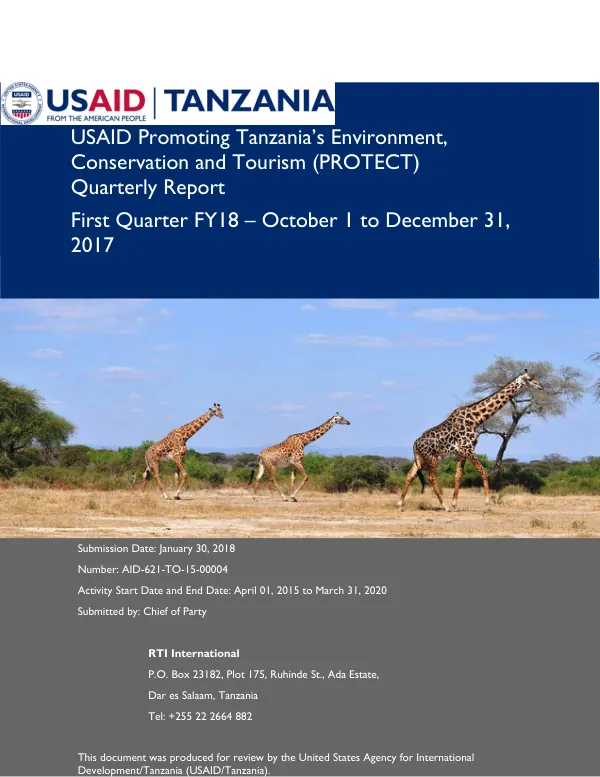
Quarterly Report 1 FY18: PROTECT Activity
The USAID Promoting Tanzania's Environment, Conservation and Tourism (PROTECT) Activity is a five-year project aimed at addressing dynamics in Tanzania that threaten biodiversity conservation and inhibit private sector-led tourism growth.
2018 · 33 pages
Sign in to readA free account is required to download.
Abstract
The project is designed to strengthen Tanzanian organizations that are, or should be, at the forefront of wildlife and conservation policy reform and implementation. These organizations include government agencies, non-governmental organizations, and private sector entities. The PROTECT Activity is being implemented by RTI International, with subcontractors and grantees including the African Wildlife Foundation, TRAFFIC, Community Wildlife Management Areas Consortium, Lawyers' Environmental Action Team, Tanzania Natural Resource Forum, Jane Goodall Institute, and Protected Area Management Solutions. Major counterpart organizations include the Government of Tanzania, Ministry of Natural Resources and Tourism, Wildlife Division, Likuyu Community Based Conservation Training Center, and Tanzania Tourist Board. The project's geographic coverage is at the national level, with specific support to USAID Priority Landscapes, including the Greater Ruaha / Rungwa/ Kitulo landscape, northern Tanzania's conservation tourism zone, and western Gombe, Masitu, Ugala Landscape. The reporting period for this quarterly report is October 1, 2017, to December 31, 2017. The PROTECT Activity is addressing several key issues, including policy reform, institutional strengthening, and private sector investment in the wildlife sector. The project is also focusing on integration of cross-cutting issues, such as gender equality and women's empowerment, youth engagement, and local capacity development. Additionally, the project is promoting stakeholder participation and involvement, and monitoring and evaluation are key components of the project's implementation. During the reporting period, the PROTECT Activity made significant progress in implementing its activities. The project's intermediate results, which include policy, research, and advocacy, institutional strengthening, and strengthened private sector investment in the wildlife sector, were all advanced during this quarter. The project also made progress in integrating cross-cutting issues, such as gender equality and women's empowerment, and promoting stakeholder participation and involvement. The project's management and administrative issues were also addressed during this quarter. The project's staff, finance, and monitoring and evaluation systems were all functioning effectively, and the project's implementing partner, RTI International, was able to address comments from the last quarterly report. Overall, the PROTECT Activity is making significant progress in addressing the dynamics in Tanzania that threaten biodiversity conservation and inhibit private sector-led tourism growth. The project's focus on policy reform, institutional strengthening, and private sector investment in the wildlife sector, as well as its integration of cross-cutting issues, is expected to have a positive impact on the conservation and tourism sectors in Tanzania. The project's geographic coverage is at the national level, with specific support to USAID Priority Landscapes. The project's reporting period is October 1, 2017, to December 31, 2017. The project's implementing partner, RTI International, is working with subcontractors and grantees to implement the project's activities. The project's intermediate results include policy, research, and advocacy, institutional strengthening, and strengthened private sector investment in the wildlife sector. The project is also focusing on integration of cross-cutting issues, such as gender equality and women's empowerment, and promoting stakeholder participation and involvement. The project's management and administrative issues were also addressed during this quarter. The project's monitoring and evaluation systems are in place, and the project's implementing partner, RTI International, is able to address comments from the last quarterly report. The project's staff, finance, and monitoring and evaluation systems were all functioning effectively during this quarter.
Related documents